Condensed Thoughts on 1619 Project

Last Weekend, there was enough debate about the 1619 Project that I wanted to put together some of my basic thoughts.

  1. Perspective. The ultimate significance of the #1619 Project is that it replaces the “Founding Fathers” with Black American history as the center of the American national narrative.
  2. Nikole Hannah-Jones sketches out a history of the Middle Passage, slavery, Reconstruction, and the Civil Rights movement as the primary current of democratic progress in the U.S. Working from a multicultural premise, black leaders and black culture worked out a more effective concept of universal liberty than the white authors of the Declaration of Independence and Constitution.
  3. An Objection: Hannah-Jones portrays Black Americans as “perfecting” an American Democracy which can be seen in the Constitution in a form distorted by slavery and white supremacy. To the contrary, the 18th century founding of the U.S. established a “White Republic” and the current political crisis can be seen in terms of a determined backlash against the transition to a multiracial and socially liberal democracy.
  4. Necessity. For political and cultural reasons, the history of black people in the U.S. needs to be seen as the backbone of multiracial, socially liberal democracy.
  5. Permutations.  Hannah-Jones writes about the way in which the Black Civil Rights Movement provided a model and impetus for other populations. “But the laws born out of black resistance guarantee the franchise for all and ban discrimination based not just on race but on gender, nationality, religion and ability.” Indeed, campaigns for feminism and the rights of LGBT, immigrants, natives, and the disabled have all been permutations of the Black Civil Rights Movement.

Further Thought on Black “Otherness”

I am still focused on the ways in which whites view black people as “the other.” Once again, this is highly concentrated and written without much context.

1. Before the 1830’s, whites in Philadelphia were very reluctant to portray blacks as “the other” because they refused to recognize blacks as having enough status to engage in “self-other” relationships. Doing so would recognize black people as part of “society” and that was a basic gesture of respect whites refused to extent.

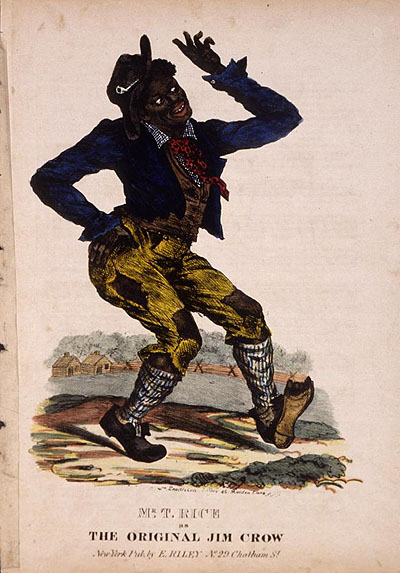
2. With the “Jim Crow” act of T.D. Rice, whites articulated a full concept of black otherness based primarily on the fantasies of blackness articulated by Rice and other minstrel performers. Whites consumed and internalized a commercially developed “fantasy of blackness” from blackface minstrelsy and then opposed themselves as “the self” to that (fantasized) black “other.”

3. Given the internalization of such fantasies of blackness, white people experienced the racial self-other opposition primarily as a dimension of white self-awareness and only secondarily in relation to any contact they had with black people in the social world. This created a number of complications because whites insisted of the realism of blackface fantasy in opposition to the realities of their encounters with black people

According to W.E.B. DuBois, The Souls of Black Folk, ” the Negro is a sort of seventh son, born with a veil, and gifted with second-sight in this American world,—a world which yields him no true self-consciousness . . . ” But early blackface makes it necessary to reconsider this pronouncement. Given that early blackface minstrelsy created a white identity predicated on fantasies of blackness, it may have been that the white world was itself so heavily veiled that it was unknowable to both black people and white people themsleves.

4. During the mid-1830’s and early 1840’s, the minstrel performers who emerged after Rice deployed racial stereotypes in a way that defined “blackness” as a form of “comic substance.” On top of the “Jump Jim Crow” images of black skin, dialect, poverty and hair, the newer minstrel performers developed images of misshapen and absurdly phallic black hair, noses, lips, feet, and heels. For performers like J.W. Sweeney (pictured above), black people were the “other” in the sense of being a fantasy of comic substance.

5. White popular culture accompanied the fantasy of blacks as “comic substance” with an idea of enjoying the suffering of black people from disease, death, dismemberment, grief, and being sold further South. Laughter had always been a dimension of blackface, but the laugher took on even more of a leering, sadistic quality once black otherness was conceived in terms of comic substance.

6. With black otherness being defined as comic substance, the enjoyment of black suffering a primary mode of bonding and group solidarity in white popular culture. There were many ways in which being white was contingent on enjoying the suffering of black people.

Rep. Andrew Clyde: Insurrectionist Ally

Rep. Andrew Clyde (R-GA) wasn’t just lying “about” the Jan. 6 Insurrection, he was lying on “behalf” of the Insurrection. One of the main questions about the Insurrection is the extent to which it was supported by the 147 House Republicans who voted against approving the election of Joe Biden. By lying in this kind of egregious way, Rep. Clyde is outing himself as an insurrectionist ally.

Photo by J. Durkin

No One Debating Marjorie

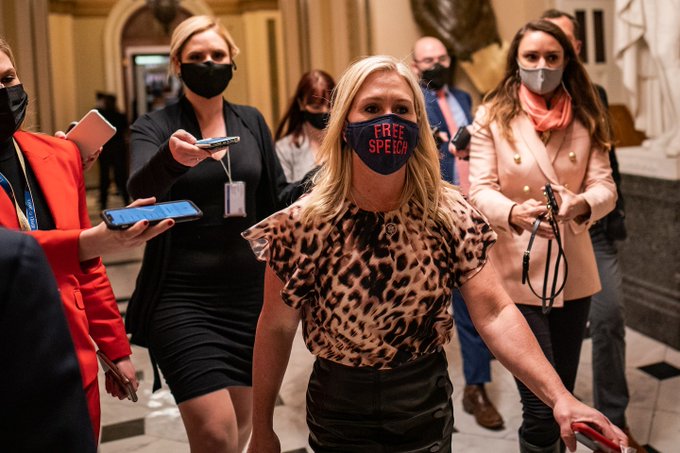
Marjorie Taylor Greene’s major function in Congress is wasting everyone’s time with procedural motions. But yesterday Greene also tried to bully Rep. Alexandria Cortez-Ocasio by yelling at her about supporting Black Lives Matter and Antifa and especially about AOC’s refusal to debate her about the Green New Deal.

Greene’s problem goes beyond her support for QAnon and supporting calls to execute Nancy Pelosi. Since Trump’s election in 2016, leftie/liberal attitudes toward conservative have changed from “condescension” to “contempt” and people on the center-left are no longer willing to debate conservatives on economic policy, abortion rights, trans rights, or any other kind of political or cultural issue.

That represents an enormous shift among white Americans. Political debate used to form a common ground between liberals and conservatives.

But that common ground disappeared.

A Note on Blackness, Democrats, and American Identity

For all the discourse around Black Americans, there is not much of a sense of the part played by Black people in American politics and society. Social and political discourse is overburdened by dichotomies like conservative vs liberal, moderate vs progressive, identity vs class that don’t fit most Black voters particularly well. The main questions usually posed are whether trends in Black voting help or harm the Democrats. Is Black turnout up or down and what percentage of Blacks are voting for the Democratic candidate? Is that enough for the Democrat to win or lose?

I get it!

On the presidential level, huge Black turnouts and 90% of the Black vote are the only ways for Democrats to win. But the role of Black voters, politicians, and celebrities in shaping contemporary American life and history goes far beyond that and I’d like to briefly suggest ways Black people are the driving force by which the Democrats are defining a new kind of national political culture.

Most of the social movements informing the Democratic Party values and policy are permutations of the Black Civil Rights Movement of the 1950’s and 1960’s. That includes feminism, disability rights activism, LGBT rights movement, and immigrant movements all of which have long been dominated by the civil rights principles and language. As a result, Democratic Party and American discourse is permeated with a language of diversity, inclusion, anti-discrimination, social justice, equity, abortion rights, contraception rights, and salary disparity. There is also a continuous stream of Black, women’s, LGBT, Native, and Hispanic “firsts” which represent civil rights milestones for each group as well as individual achievements. The discourse of “firsts” is one way but an important way in which Kamala Harris, Nancy Pelosi, Pete Buttigieg, and Deb Haaland have broad historical significance. The language and the values embedded in civil rights discourse are also personified by the most iconic figures of the last 60 years. A short list includes Martin Luther King, Rosa Parks, Barack Obama, and John Lewis but also reaches back to W.E.B DuBois, Frederick Douglass, Harriet Tubman, and others. Likewise, works like the #1619Project are indications that the conditions and perspectives of Black Americans are becoming central to the historical sense of American identity.

Blackness as a Universal Vulnerability

Going back to this picture of T. D. Rice as “Jim Crow,” a question that needs to be asked is “what does it mean to be black” in the context of early blackface.

There are several answers.

Within early blackface, being black partly meant being understood through physical stereotypes such as dark skin, protruding lips, a particularly large nose, “woolly hair,” African dialect, a large derriere, and extended feet and heels. The primary social stereotype for blackness was the all-encompassing poverty represented in the “Jim Crow” picture through holes in shoes, wrinkled and torn pants, and a worn out hat.

The main connotation of physical and social stereotypes was that blackness was a degraded condition–particularly vulnerable, dependent, enslaved or barely out of slavery, deprived of the necessities of life, targeted by (white) violence, human in a form that can be readily questioned, denied, and laughed at. From the late 1820’s to the 1840’s, white men had an intense fear of falling into the kind of degradation associated with blackness. However, they also sought to distance themselves, master, and adapt the image of “degraded blackness” and T. D. Rice paved the way for doing so by adapting blackface make-up and costuming and performing as “Jim Crow.”

How extensive was the vulnerability involved in the representation of “degraded blackness?” The best analogy would be delirium tremens, a condition that still strikes alcoholics and drug users who suddenly reduce or eliminate their high levels of alcohol and drug consumption. In the first stage of delirium tremens (or mania a potu as it was most often called from the 1820’s-1840’s), men experienced the entire environment as assaulting them and themselves as intensely vulnerable with seemingly their whole bodies exposed to danger.

In representing himself as a black man, Rice was doing the same. It wasn’t just that his skin and hair were black or that he was wearing ragged and torn clothes, or that his shoes had gaping holes. Instead, Rice’s “Jim Crow” conveyed a total or universal vulnerability to the world. In Workingmen’s imagery, men could analogize themselves to vampires or incubuses that were attached to them and attacking them as though they were women. Later in the 1830’s, William Burton put songs about men being killed by mechanical arms and wooden legs that they could not control. More than “attached” these threats were partially occupying men and leading them to painful deaths.

But the figure of Jim Crow anticipated Burton by representing men as fully occupied by blackness and that blackness as an indicator of an extreme kind of vulnerability. For white men in Rice’s audiences, it was like delirium tremens with their whole exposed, almost as if their skin had been torn off and their insides exposed. This “display of degradation” is what gave blackface much of its power with white audiences.

The Democrats and Their Insurrectionist Opponents

Rep. Steve Scalise (White Nationalist-LA), the No. 2 guy in the House GOP, announced today that he supports replacing Liz Cheney as the House No. 3 with Elise Stefanik (Trump Toady-NY).

Jokes aside. The Liz Cheney episode is a founding moment for the Republican Party that confirms the profound changes in the party since 2015.

The Republican Party is now an insurrectionist, white nationalist party with Trump’s Big Lie about the 2020 election as their founding text.

What of the Democrats? That’s a more complex case because the Democrats are a more complex although also rapidly changing party.

A brief definition:

The Democrats are primarily a civil rights party born of the 1950’s-60’s Civil Rights Movement and its permutations into feminism, disabled rights, gay rights, trans rights, and environmentalism. The Democrats are a party of diversity, equity, and sustainability. They are also a party of anti-racism and opposition to bigotry and the abusive of vulnerable populations.

The Democrats don’t really have a foundational text, but I would think of the work of Martin Luther King, the debate between King and Malcolm X, and the Civil Rights Act of 1964 and Voting Rights Act of 1965 as starting places.

An Assimilation Problem

Josh Hawley (@HawleyMo) has an assimilation problem in that he refuses to assimilate into 21st century multicultural, socially liberal America. In the increasingly insurrectionist Republican Party, the refusal to assimilate is the ticket for admission and Hawley uses the language of “cancel, censor, and silence” to advertise his status as an “outsider.”

https://twitter.com/search?q=Josh%20Hawley&src=typed_query

Fundamentals of American Instability

The United States became an unstable society the minute Donald Trump caught fire among Republican primary voters in the Fall of 2015.

Or was it when Obama was elected in 2008.

Perhaps both.

The furious right-wing response to Obama’s election as the first black president overshadowed the extent to which an urbanized, multiracial and socially liberal coalition coalesced behind Obama.

By 2015, white conservatives caught on and Trump ran against “Obama’s America” almost as much as he ran against Hillary Clinton. Caught up in long-term Clinton grudges and Bernie v Hillary drama, the Democrats were incapable of mounting a unified defense of their emerging culture and Trump as able to squeak by despite losing the popular vote.

After Trump took office, it was a now unified Democratic coalition that mounted a furious reaction and kept the heat on Trump all four years. But that overshadowed the extent to which the GOP voting base and Trump were shaping each other into a fascist movement that is animated by a cult of personality, longing for political violence, and opposed to American democracy.

The Democratic coalition increased its vote by 16 million in the 2020 presidential election and is unified around Biden. But the Trump cult has solidified in the Republican Party and local Republicans have been inspired to pass legislation seeking to rig future elections and put protesters in jail.

At this point, the quickly evolving dynamic of American instability is the opposition between multicultural democracy and Trump-centered fascism.