Is Trump in Control of His Own Domain?

The news on Saturday, Dec. 3 was that former president Trump called for “terminating” the Constitution and either re-installing him as President or holding a new election. It’s been known since before the Jan. 6 Insurrection that Trump was all for overturning the Constitution if that meant he could stay in office as President. Much of the outrage over Trump’s statement was a renewal of the outrage over Trump’s Jan. 6 coup attempt and the revelations in Cassidy Hutchinson’s testimony that he wanted to join the assault on the Capitol. Trump’s statement also fed into the anxiety over the threats to American democracy posed by the GOP right wing and a determination to prevent new attempts to overthrow the constitutional system
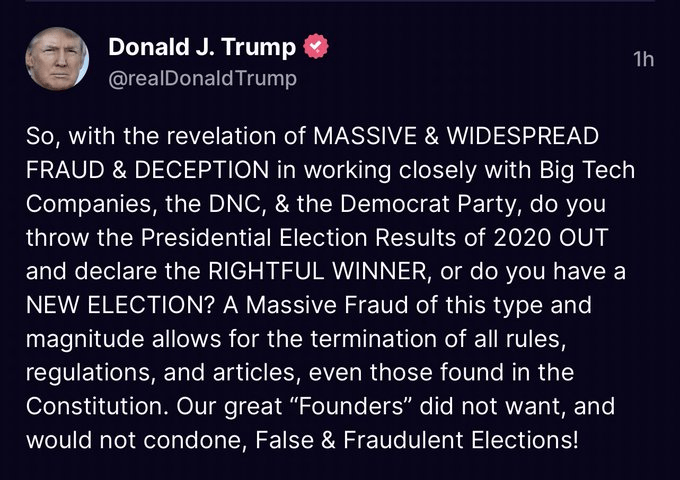
Donald Trump, Truth Social

But I also believe Trump’s outrageousness was designed to shore up his suddenly vulnerable position on the political right and that the defensive dimension of Trump’s gesture also needs to be understood. The weakness of Donald Trump’s post-midterm election position has been widely discussed. While Trump’s only significant GOP rival, Florida Governor Ron DeSantis, was winning re-election by almost 20 points, Trump recruits like Blake Masters (Arizona) and Mehmet Oz (Pennsylvania) were being defeated in races for the U.S. Senate while Herschel Walker faces a Tuesday runoff where his Democratic opponent Sen. Rafael Warnock is favored. Perhaps even worse, Trump-favored Ohio candidate J.D. Vance only won because Mitch McConnell injected tens of millions of dollars into his flagging campaign. After the mid-terms, the difficulty of Trump’s position was confirmed by polling showing DeSantis leading Trump for the first time among GOP primary voters.

But that wasn’t all.

Trump’s political vulnerability within the Republican Party was magnified by his pre-Thanksgiving lunch with anti-semitic rapper and 2024 presidential candidate Kanye West (who now goes by “Ye”) and podcasting America First fascist Nick Fuentes. According to veteran far right activist Milo Yiannopoulos, the inclusion of Fuentes in the lunch was designed to cause a scandal and thus make Trump miserable because of Trump’s disloyalty to far right fringe extremists in his political base.

And it worked.

Because of the slow Thanksgiving news weekend, Trump’s dinner with Ye and Fuentes was the main story in the news for seven or eight days afterwards and was only fully displaced by last Thursday’s appearance of Ye and Fuentes on the Infowars broadcast of extreme right-wing conspiracy theorist Alex Jones (himself fresh off losing a $1B libel suit by Sandy Hook parents). Ye talked about how much he loves Nazis, how Nazis are cool, and continued his anti-semitic attacks while brandishing a net and a Yahoo to ridicule former and soon to be Prime Minister again Benjamin Netanyahu of Israel. Ye was mainstreaming a form of Nazi propaganda which Jewish people in the United States saw as threatening even larger-scale domestic terrorism against them in the near future. Ye and Fuentes were posing a challenge to the Trump right as well. Part of what charmed white conservatives about Trump in 2015 and 2016 was Trump’s willingness to say and do anything, his giddy transgressions of longstanding norms, and eagerness to break taboos. But now it was Ye breaking the taboos against open anti-semitism, ridiculing Trump ally Benjamin Netanyahu’s Jewish name, and bragging that Yiannopoulos, Fuentes, and he had punked Trump about the Mar-a-Lago lunch. Days later, Fuentes launched an attack on Trump ally Marjorie Taylor Green for her adultery, (pending) divorce, and status as a “girl boss.” The lunch with Trump and the InfoWars incident had given Ye and Fuentes enough media status that they could attack Trump and conservative Trump supporters like Greene from a still further right position. Where Trump made portentous demeaning gestures about blacks, women, and immigrants, Fuentes made his commitment to male and white supremacy open and forthright.

What Trump sought by his Truth Social post about terminating the Constitution was to reassert his pre-eminence as the dominant figure on the American right. DeSantis might have success fighting “wokeness” in Florida but it was Trump who had the “guts” to “terminate” the Constitution. Nick Fuentes might have called for a “dictatorship” but Trump was the political heavyweight who could make that a real possibility. Trump occupies what anthropologist Victor Turner called a “liminal position” in the politics of the American right. During his first presidential campaign, Trump single-handedly defined a discourse around himself in terms of dominance, but the multicultural and liberal opposition grew stronger during his administration and Trump lost re-election despite the powers of incumbency. As a result, Trump’s current claims to dominance are so shadowed by failure that he’s now facing competing claims on the right and Trump announcing that the Constitution should be terminated should be seen as a re-assertion of his pre-eminence.

Democrats Blowing Out the Insurrectionists

Society vs Backlash. America has been destabilized by two broad and related developments, the evolution of a multicultural, socially liberal mainstream and a bitter backlash among white conservative best seen in terms of permanent insurrection. Politically, the Democrats are the party of multicultural mainstream America and indeed the civil rights, diversity politics of the Democrats has been one of the main vehicles for creating and defining that mainstream. But politics is also important for understanding the destabilizing and dangerous white conservative backlash. As America’s conservative party, the Republicans have been a focus of backlash since Donald Trump’s 2016 presidential campaign and backlash phenomena like MAGA, QAnon, the Big Lie, the re-articulation of bigotry as “anti-woke,” and the campaigns against transsexual teens and drag shows are intimately connected with GOP politics.

Politics of Insurrection. The assault on the Capital building in Washington was an attack on the United States on the same level as the Japanese strike on Pearl Harbor that brought America into WWII and al-Qaeda’s attack on New York City, the Pentagon, and the Capitol on 9-11. The American media has under-estimated the extent to which the insurrectionary energy of Jan. 6 continued for more than a year after President Biden’s inauguration. There were many examples of insurrectionary activity, including the continuation of the QAnon movement, all the bizarre conspiracy theories around Covid vaccines, and local insurrectionary activism in places like Idaho. In politics, insurrectionary energy focused around the Supreme Court taking a case that would allow state legislatures to ignore the popular vote in presidential elections, MAGA fascists like J. D. Vance, Blake Masters, Doug Mastriano, and Kari Lake running for governor and Senate positions, and a number of Republican candidates for the state Secretary of State positions that controlled elections in the states. GOP Secretary of State candidates in Michigan, Arizona and Nevada all claimed (one way or another) that Democratic candidates could only win by fraud and promised to attack voting by Democratic constituencies.

Blowing Out the Insurrectionists. Of all the insurrectionists who ran for major office, J.D. Vance was the only one who won and that only happened because of a major injection of cash from Mitch McConnell. Insurrectionist Republican Doug Mastriano lost by 15 in the race for governor in PA, Blake Masters by 5 for the Senate seat in Arizona, and Tudor Dixon by 10 for governor of Michigan. The most prominent of the insurrectionists running for statewide office was Kari Lake in Arizona and she’s currently trailing by 34,000 in a still undecided race and Adam Laxalt has lost in Nevada now that all the votes are counted from Las Vegas. Even more to the point, all of the insurrectionist candidates lost for Secretary of State offices in Arizona, Nevada, Michigan, and Wisconsin. For example, Arizona GOP Secretary of State candidate Mark Finchem lost by 5.6%, Kristina Karamo by 14% in Michigan, and Jim Marchant in Nevada by 2% (where the GOP won the governor’s race and only lost in the Senate by 5,000 votes). Insurrectionist candidates like gubernatorial candidate Tim Michels of Wisconsin wanted to guarantee that  “will never lose another election” in their states but were turned back by their Democratic opponents.

When Will Normal Become Normal? Hard left podcaster Matt Christman tweeted that Democrats did well in the 2022 mid-terms because they are the “normie” party and were able to remain “normal” despite determined Republican efforts to “flip that by associating them with crime and immigrants and gender sickos.” Christman added that “[t]his is problematic for people who are obsessed with defining themselves in counter-cultural opposition to the normie mainstream, but ON BEHALF of some imagined heartland “normal” American.” Of course, the “counter-cultural opposition” isn’t much of a force in American life and indeed it seems that multicultural and liberal Democrats have not been able to establish as “normal” even though they were successful in portraying themselves as “more normal” than MAGA Republicans. That’s because the far more powerful force of the mainstream news media agrees with both the counter-culture and Republicans in imagining a “normal America” of small towns, small business, farms, and factories in which the template is white conservatism even though Democrats do make inroads. That’s why the New York Times, CNN, and Politico sent so many reporters trekking to diners, bars, and gun shows since 2016. Like Paul Simon, they all wanted to “look for America” or at least the “normal America” that they thought was Saginaw rather than NYC, Chicago, or Detroit. In 2022, the Democrats were able to portray the MAGA extremists of small town America as threats to democracy but were not able to establish their own multicultural, socially liberal base as the American normal. Even though the Democratic coalition “is” the norm, it doesn’t “seem” to be the norm. And that’s still a problem.

Today’s Election

The Election: Today is the mid-term election for the U.S. Senate and House of Representatives with elections for Governors and other state officials all over the country as well as local elections for mayors, sheriffs, county officials, city councils, judges, and a deluge of special voting districts on the local level. In my state of KY, there’s an election for county Judge-Executive, Mayor, County Attorney, Commonwealth’s Attorney and Sheriff. There are no elections for state office, but there are two constitutional amendments on the ballots, one Senate seat (held by Rand Paul) and the member of the House of Representatives from our Congressional District (KY-05). That office is currently held by the worst public speaker I’ve ever heard and one of the most obscure members of the House, long-time Kentucky Republican Hal Rogers.

National Overview: The big question in American politics is whether President Biden and the Democratic Party maintain their very slim advantage in Congress where the tie-breaking vote of VP Kamala Harris gives the Democrats a slight edge in the Senate where seats are evenly divided between Democrats and Republicans. In the 435 member House of Representatives, Democrats only have to lose five seats to lose their majority.

Unfortunately for the Democrats, there is a deeply ingrained historical pattern of the president’s party losing seats in mid-term elections and the Democrats are predicted by most observers to lose anywhere from 10 to 43 seats in the House in today’s election. Therefore, the Republicans are expected to have a majority in the House of Representatives and California Republican Kevin McCarthy is expected to succeed Democrat Nancy Pelosi as Speaker of the House.

The Senate is perceived to be more up in the air but the Republicans are widely seen as favored to take control of the Senate as well. The reputable FiveThirtyEight site views the Republicans as “slight favorites” to take control of the Senate with a one vote margin based on their view that Herschel Walker will defeat Rev. Rafael Warner in Georgia. The Cook Political Report also sees the Republicans as gaining one seat and regaining control over the Senate. So does long-time University of Virginia analyst Larry Sabato. Republican observers see the Republicans as having big enough wins that the election looks like a Republican or “red wave.” The right-leaning web site RealClearPolitics predicts that the Republicans will gain three seats and views Democratic Senate candidates in states like Ohio reached the limits of Democratic support but were unable to push through in largely Republican states. Former GOP Speaker Newt Gingrich is even more optimistic about a “red wave” and predicts that Republicans will gain five seats in the Senate.

But there has been pushback from Democratic consultants and observer. Christopher Bouzy who is known mostly for his “Bot Sentinel” web site believes that it is the Democrats who “will gain at least two seats in the Senate and hold the House with 2 – 6 seats.” Christopher Bouzy justifies his prediction by citing registration and early voting data which focuses on young voters (18-29), women, and minorities. The idea is that early voting among Democrats is outpacing the high early voting rates in the “blue wave” election which say big Democratic gains in 2018. From Bouzy’s point of view, the increase in early voting means that numbers among Democratic voters compared to Republican voters and the polls thus are underestimating the Democratic vote.

The other argument made by Democratic optimists focuses on the thesis that the polls are over-estimating the Republican vote. Democratic consultant Simon Rosenberg is arguing that GOP polling firms have been “flooding the zone” with polls that are biased toward Republicans and that this has influenced poll aggregators like FiveThirtyEight.com and analysts like Cook Political Report and Larry Sabato to over-estimate support for Republican candidates. A couple days ago, Nate Silver of FiveThirtyEight.com admitted that the rush of GOP polls had affected his site’s poll average in favor of Republicans although he saw that more as correcting for the anti-GOP bias that had surfaced in 2016 and 2020 presidential polling. It makes a significant difference as can be seen in a Rosenberg tweet on the Senate race in George where the Democrat Rev. Raphael Warnock is trying to hold onto his seat vs former NFL star and Republican Herschel Walker

That’s a 7 point difference that’s not balanced out by “Democratic-leaning polls.” Rosenberg thinks the data supports Democrats but does not venture the same of prediction as Bouzy. Seeing this kind of discrepancy and observing the high rates of early voting among Democratic voters Savvy political observers like Josh Marshall of Talking Points Memo and Never Trumper Republican and former Republican National Committee Chair Michael Steele largely accept both that the rush of GOP polls has biased the poll average and that there’s been a late surge toward the Democrats. As a result, Marshall sees a fairly wide range of possibilities for the Senate elections with the Democrats possibly gaining 2 seats and holding the majority the Republicans possibly gaining 4 seats and thus gaining the majority. For his part, Michael Steele foresees a tight election that has a great deal of variability and think there will be a lot of surprises some of which will be favorable to the Democrats and some to the Republicans.

My own sense is somewhat the same as Steele’s. My suspicions is that this won’t be either a Republican “red wave” or a Democratic “blue wave” election and that there will be a number of surprises going both ways. In relation to national politics, I see three possibilities.

  1. GOP takes the House, Dems keep the Senate. House Republicans are a real threat to default on the national debt, will probably impeach President Biden, and will also keep a lot of Democrats off committees. But it’s likely that the government will remain functional.
  2. GOP takes House, GOP takes Senate. The situation would depend on the extent to which Establishment and MAGA Republicans can work together in the Senate. But the tendency of the national government toward chaos would increase with GOP control over both.
  3. Dems Take House, Keep Senate. This is the Christopher Bouzy scenario that’s still not taken very seriously. But if the Dems keep control over Congress despite mid-term trends, inflation, and higher crime rates, that would allow the Biden administration to keep functioning in its current way and create a great deal of consternation among Republicans. If they can’t win now, when will they ever win?