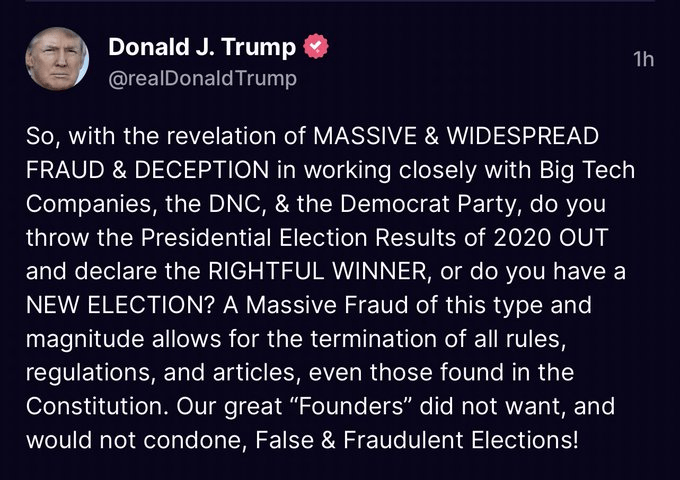
The news on Saturday, Dec. 3 was that former president Trump called for “terminating” the Constitution and either re-installing him as President or holding a new election. It’s been known since before the Jan. 6 Insurrection that Trump was all for overturning the Constitution if that meant he could stay in office as President. Much of the outrage over Trump’s statement was a renewal of the outrage over Trump’s Jan. 6 coup attempt and the revelations in Cassidy Hutchinson’s testimony that he wanted to join the assault on the Capitol. Trump’s statement also fed into the anxiety over the threats to American democracy posed by the GOP right wing and a determination to prevent new attempts to overthrow the constitutional system
But I also believe Trump’s outrageousness was designed to shore up his suddenly vulnerable position on the political right and that the defensive dimension of Trump’s gesture also needs to be understood. The weakness of Donald Trump’s post-midterm election position has been widely discussed. While Trump’s only significant GOP rival, Florida Governor Ron DeSantis, was winning re-election by almost 20 points, Trump recruits like Blake Masters (Arizona) and Mehmet Oz (Pennsylvania) were being defeated in races for the U.S. Senate while Herschel Walker faces a Tuesday runoff where his Democratic opponent Sen. Rafael Warnock is favored. Perhaps even worse, Trump-favored Ohio candidate J.D. Vance only won because Mitch McConnell injected tens of millions of dollars into his flagging campaign. After the mid-terms, the difficulty of Trump’s position was confirmed by polling showing DeSantis leading Trump for the first time among GOP primary voters.
But that wasn’t all.
Trump’s political vulnerability within the Republican Party was magnified by his pre-Thanksgiving lunch with anti-semitic rapper and 2024 presidential candidate Kanye West (who now goes by “Ye”) and podcasting America First fascist Nick Fuentes. According to veteran far right activist Milo Yiannopoulos, the inclusion of Fuentes in the lunch was designed to cause a scandal and thus make Trump miserable because of Trump’s disloyalty to far right fringe extremists in his political base.
And it worked.
Because of the slow Thanksgiving news weekend, Trump’s dinner with Ye and Fuentes was the main story in the news for seven or eight days afterwards and was only fully displaced by last Thursday’s appearance of Ye and Fuentes on the Infowars broadcast of extreme right-wing conspiracy theorist Alex Jones (himself fresh off losing a $1B libel suit by Sandy Hook parents). Ye talked about how much he loves Nazis, how Nazis are cool, and continued his anti-semitic attacks while brandishing a net and a Yahoo to ridicule former and soon to be Prime Minister again Benjamin Netanyahu of Israel. Ye was mainstreaming a form of Nazi propaganda which Jewish people in the United States saw as threatening even larger-scale domestic terrorism against them in the near future. Ye and Fuentes were posing a challenge to the Trump right as well. Part of what charmed white conservatives about Trump in 2015 and 2016 was Trump’s willingness to say and do anything, his giddy transgressions of longstanding norms, and eagerness to break taboos. But now it was Ye breaking the taboos against open anti-semitism, ridiculing Trump ally Benjamin Netanyahu’s Jewish name, and bragging that Yiannopoulos, Fuentes, and he had punked Trump about the Mar-a-Lago lunch. Days later, Fuentes launched an attack on Trump ally Marjorie Taylor Green for her adultery, (pending) divorce, and status as a “girl boss.” The lunch with Trump and the InfoWars incident had given Ye and Fuentes enough media status that they could attack Trump and conservative Trump supporters like Greene from a still further right position. Where Trump made portentous demeaning gestures about blacks, women, and immigrants, Fuentes made his commitment to male and white supremacy open and forthright.
What Trump sought by his Truth Social post about terminating the Constitution was to reassert his pre-eminence as the dominant figure on the American right. DeSantis might have success fighting “wokeness” in Florida but it was Trump who had the “guts” to “terminate” the Constitution. Nick Fuentes might have called for a “dictatorship” but Trump was the political heavyweight who could make that a real possibility. Trump occupies what anthropologist Victor Turner called a “liminal position” in the politics of the American right. During his first presidential campaign, Trump single-handedly defined a discourse around himself in terms of dominance, but the multicultural and liberal opposition grew stronger during his administration and Trump lost re-election despite the powers of incumbency. As a result, Trump’s current claims to dominance are so shadowed by failure that he’s now facing competing claims on the right and Trump announcing that the Constitution should be terminated should be seen as a re-assertion of his pre-eminence.

 Early Blackface, Cultural Change, Latest Politics