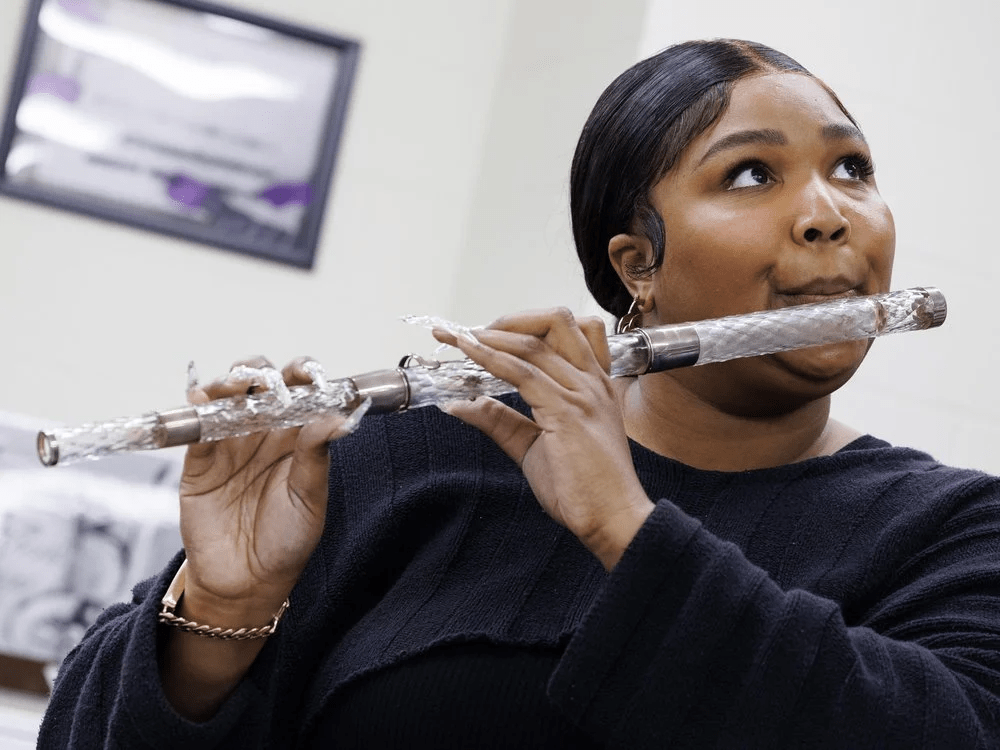
On Tuesday night, the popular rapper, songwriter, and actor Lizzo played the crystal flute originally given to President James Madison to celebrate Madison’s second inauguration as President of the United States. Growing up in Detroit and Houston, Lizzo is a classic American story of upward mobility, risk taking, and barrier breaking, Lizzo trained as a classical flautist while developing her rapping chops in teen bands and finally taking the big leap, moving to Minneapolis and living out of her car for a year while she was breaking into the music business. Being substantially overweight, Lizzo became a huge success while also overcoming stigmas about fatness at the top levels of the music business. Her talent and drive were more than enough to overcome the traditional barriers to success for “Big Grrls.”
Lizzo is the first person to play the Madison flute and she had arranged with the Library of Congress to play the flute as part of a DC area concert. As a result, she was in full rapper costume when the Madison flute was presented to her, played a few notes and did a little twerking before celebrating the historic nature of the event. Lizzo also used the occasion to put in a plug for the Library of Congress and history. “Thank you to the Library of Congress for preserving out history and for making history fricking cool. History is freaking cool you guys!”
Of course, Lizzo’s playing the James Madison flute was a way to advertise herself and provide a “special moment” for her fans but the event also had wider significance. What strikes me most is that Lizzo is a cultured professional performer, a pro, who is steeped in flute lore and recognized the significance of the Madison flute. Much has been made about Lizzo playing an instrument linked to a slave-owning ex-president and its importance in crossing another line associated with the slave system and white supremacy. But I also wonder if the significance runs deeper. Lizzo represents a different kind of society than the white patriarchal republican which James Madison had such an important role in establishing as an author of the Constitution and the Bill of Rights. In Madison’s America of Madison, white men had full rights while women, black people, and other non-whites were refused legal recognition as citizens, exposed to extensive surveillance, and subject to the slave system in the case of most black people. To the contrary, Lizzo’s America is a multicultural, socially liberal society in which the official values stem from the Civil Rights era of the 1950’s-1960’s and Lizzo’s career is an exemplar of the barrier-breaking accomplishments of black women within that society. Lizzo’s excellence as a flute player and interest in flute lore has been a way for her to assert historical roots in relation to the historical marginalization of black women. But her performance with the flute also brought the artistic legacy of the 1810’s back into contact with the mainstream of multicultural popular culture and gave the Madison flute a cultural vitality it never had before. Madison himself never anticipated this, but the best of Revolutionary era culture lives on through Lizzo.
There was also this very curious reaction.
What’s curious here are the terms “victorious revolutionary regime” and “defeated enemy.” Who is the “defeated enemy” here? The relevant parties to the exchange are Lizzo and the Library of Congress with Lizzo seeking a special moment for her fans and the Library of Congress looking to increase its public visibility. Far from being a “victorious revolutionary regime” and “defeated enemy,” Lizzo and the library were involved in a cooperative exchange and the Madison flute was not only not a “sacred object” it was obscure, unplayed, and almost unknown until Lizzo played it. That the flute can now be considered a “sacred symbol” of American history is almost entirely due to Lizzo herself. Much as the 1619 Project unlocked the potential to construct new narratives about the history of American democracy, Lizzo created a new kind of connection between the multicultural present and the White Republic of 200 years ago.
Perhaps “Martyr Made” is referring to white conservatives as the “defeated enemy.” But traces of conservative defeat are difficult to find in the Madison flute event. It’s not like the positive, upbeat messages of Lizzo songs like “It’s About Damn Time” represent hostility to conservatism let alone the conquest of conservatives. In fact, there isn’t much reference to conservatives in the Madison Flute event at all. Maybe that’s the problem though. During the slavery and segregation periods, “conservative” figures employed their economic, police, and ideological power as well as sporadic and intense violence to curtail black people like Lizzo and Carla Hayden, the first black woman to head up the Library of Congress. However, Hayden was backed up by a multicultural Biden administration and the broader American cultural elite while Lizzo is an established star in hip hop and the only vehicle for conservative involvement was protest from conservative media figures like Ben Shapiro. Laying out the full scope of white conservative impotence, conservatives had no ability to prevent the Lizzo/LOC event from happening, no capacity to punish the organizers and participants, and no ability to prevent either Lizzo or the Library of Congress from doing similar things in the future. In relation to conservatives, Lizzo wasn’t so much triumphing over conservatives as forgetting that they exist.
Further thought on Lizzo’s current moment can be derived from reflection on this tweet from reactionary right-winger Pedro L. Gonzalez, a writer and associate editor at an outlet called Chronicles Magazine which I’ve never heard of but has enough prominence that Ann Coulter follows them on twitter. Where “Martyr Made” views Lizzo playing the Madison Flute as the victorious gesture of the conquering over the defeated, Gonzales identifies white people as the group being conquered and the Lizzo event as specifically “about humiliating white people.”
Gonzalez uses the term “white” in an unreflective way and just assumes that having a European genetic heritage makes a person white in the sense of being part of a white “people.” But I don’t believe that a white “people” exists any more in the United States and that indeed the growing and increasingly bitter cultural divide among the white ethnic population is one of the unique features of current American society. Speaking very broadly, about 40% of the white population in the U.S. votes Democratic, white Democrats represent about 60% of the Democratic vote, and thus white Democrats are the largest element in the multicultural Democratic coalition. White Democrats accept the civil rights morality associated with the Black Civil Rights Movement, 2nd Wave feminism, disabilities activism, LGBT rights, and immigration activism, and liberal white acceptance of civil rights principles has been a crucial factor in civil rights perspectives becoming the more or less official ideology in the United States. Gonzales stresses in one of his articles for Chronicles Magazine that Critical Race Theory is so pernicious because it’s “anti-white,” but he quotes white writer and cultural critic Susan Sontag to justify his point. In my experience, white Democrats greatly admire black figures like Frederick Douglass, Martin Luther King, and Malcolm X, enthusiastic about the success of barrier-breaking black cultural figures like Lizzo, deeply critical of the slave system, segregation, and contemporary white racism, and have a hard time viewing those who see America as a “white man’s country” as real Americans. White Democrats may not form a “common culture” with Black people, Native Americans, and immigrants but white Democrats are definitely a large and active element in the multicultural coalition opposing white conservatives.
Instead of humiliating white people, Lizzo created an event which all factions of America’s multicultural society could accept and enjoy, and forget for a moment about this nation’s problems with the insurrectionary right.

 Early Blackface, Cultural Change, Latest Politics