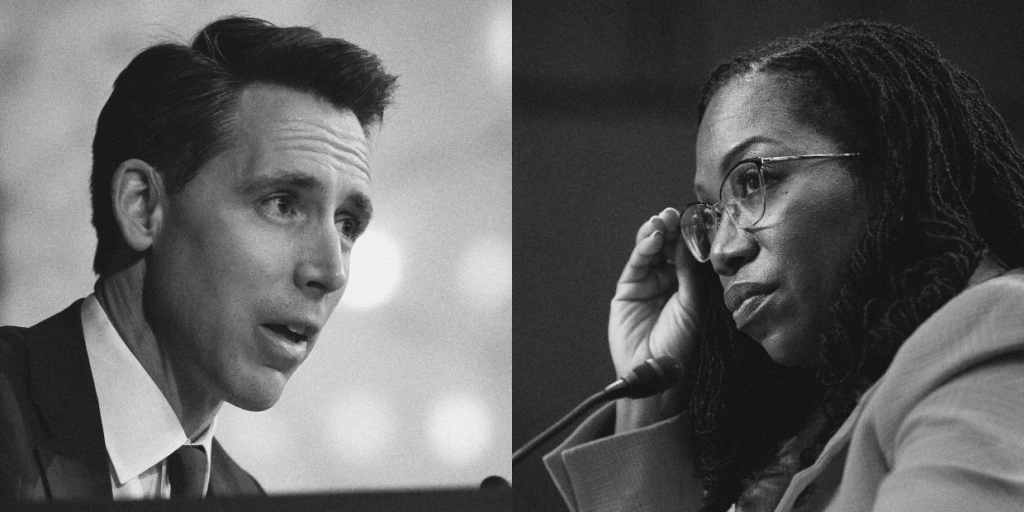
The Mourning, the Resentful, and the Bitter

Josh Hawley, Ketanji Brown Jackson, @MSNBC

In her @Salon article comparing the Ketanji Brown Jackson hearings to the confirmation hearings for Thurgood Marshall, Margaret Russell of Santa Clara University views the Republican senators who badgered Judge Jackson as acting in a manner similar to the racist Dixiecrats who questioned Justice Marshall during his confirmation hearings in 1967.

Like the Dixiecrat senators — Democratic senators from the South who believed in white supremacy — who grilled Marshall about his views on crime, the present-day Judiciary Committee Republicans have repeatedly insinuated that Jackson is soft on crime for performing her job responsibilities as a defense lawyer and trial judge in a manner that has been shown to be well within the mainstream of these legal roles.

Prof. Russell focused on Republican fear-mongering about crime and Critical Race Theory and she didn’t indicate whether or to what extent contemporary conservative Republicans share the belief in white supremacy so characteristic of their Dixiecrat forebears. However, what leading Republicans, GOP affiliated groups, and Republican voters think about race is an important issue in American politics. For “Portia Vaxxed and Boosted McGonagal” writing on twitter, conservatives are afraid that they would be treated the same way they treat “others,” meaning Black people, other racial minorities, undocumented immigrants, and LGBT folks.

Thinking about the issue in relation to the hearings, I believe a closely connected set of racist attitudes can be identified for conservatives which is distinct from the liberal racism discussed by Robin DiAngelo in White Fragility.

Persisting White Supremacy. In the contemporary context, white supremacy is a centuries long-standing belief that Black people are inferior to white people in intelligence, morality, and overall civilization, and are therefore rightfully excluded from occupations, subject to surveillance, harassed by police, and followed by store security. That belief is expressed in scholarly writing like The Bell Curve and by prominent defenders of The Bell Curve like journalist Andrew Sullivan, police officers celebrating the murder of black men like George Floyd, and the legions of “Karens” trying to monitor or exclude black people from parks, public pools, stores, and other places. Out of the public eye, these persistent racists use the n-word prolifically, tell racist jokes, make derogatory racial comments about black entertainers, athletes, and politicians, and share a sense of solidarity with white family members, friends, and co-workers who do the same. The main historical reference is the segregation system of the post-Civil War White South but 20% of Republicans believe that emancipation from slavery was a mistake. For hard-core racists, a culture of white supremacy is important to them even if they say they don’t really mean it, give “color-blind” excuses, or say that Blacks are the ones who are “really racist.”

Resentment Over Moral Criticism. White supremacists resent being morally criticized for racism even more than they enjoy participating in racist socializing. They get upset at being called racists because of the widespread moral stigma attached to racism by “official” public ideology in the United States. For Tucker Carlson of Fox News, his resentment of being called a racist is so intense that he cited it as his first reason for preferring Vladimir Putin and Russia over the Democrats and the United States as the beginning of the Ukraine crisis. “Has Putin ever called me a racist? Has he threatened to get me fired for disagreeing with him? Has he shipped every middle-class job in my town to Russia?” White supremacists view themselves as anchoring American society, as “the people,” but being called “racist” casts them outside the mainstream as condemns them as evil, bad, ignorant, and in fact marginal to the larger American society. The core of the resentment lies in white supremacists recognizing both that the official ideology of the United States is “rejection of racism” and that the official ideology is appropriate. However much white supremacists dodge, dissemble, and fight against it, they agree with the official ideology, know their own cultural marginality, and already have a resentment of that marginality before any of their critics remind them. In other words, white supremacists resent being called out for the immorality they already know in themselves.

Bitterness over Black Advancement. The bitterness over black advancement has a long history going back at least to the 1820’s and comes in many forms, but exploded into American society with the election of Barack Obama and the flowering of birther conspiracies that emerged in the racist backlash against his election. But white supremacists harbor a great deal of bitterness over any black achievement or mainstream notoriety and express that bitterness in diatribes over black athletes, black politicians, black musicians, black actors, and black business people. They spit out “wealthy athlete” or “wealthy celebrity” in a way that emphasizes their contempt for black people being wealthy or famous in the first place. The most recent example of that bitterness came out in a Charlie Kirk diatribe against the first black woman Supreme Court nominee, Ketanji Brown Jackson

Charlie Kirk, @MediaMattersForAmerica

Charlie Kirk: Well, KBJ – Ketanji Brown Jackson – is what your country looks like on critical race theory. KBJ is your country on CRT. KBJ – Ketanji Brown Jackson – is an embodiment of the tyranny that we currently live under. She’s an ideological, unintelligent, yet confident fanatic . . . What do you get when you start to platform and implement critical race theory into every single corner of American society, in your corporations, in your schools? Your children and your grandchildren are going to have to take orders from people like her. And what’s amazing is that she kind of has an attitude too. You, look carefully at some of those videos, she kind of just she’s like, what? Why are you answer – why are you asking me such a question, Senator? She feels entitled to this position. Why wouldn’t she? It’s not like she got this position based on her qualifications. It’s not like she was selected based on her qualifications, it’s not like she was selected because of her amazing rulings. Of course not.

Charlie Kirk knows his audience. So the bitterness runs wild. Jackson doesn’t deserve to be on the Supreme Court (“it’s not like she was selected based on her qualifications”). Jackson is “an unintelligent, yet confident fanatic.” As a black woman, Ketanji Brown Jackson is undeserving of a Supreme Court seat and Charlie Kirk is bitter about it, but Kirk is also bitter about the nature of the society that could appoint a Black woman like Jackson. According to Kirk, Jackson is a product of the most evil dimensions of American society, “an embodiment of the tyranny that we currently live under.” Jackson is what you get “when you start to platform and implement critical race theory into every single corner of American society.” In this sense, Ketanji Brown Jackson stands for all the black and women who have a consciousness of being black (being “woke” in what is now conservative terminology). Not only is Kirk is bitter about that but he is also bitter about the impact of the advance of black people on the lives of future white conservatives–“Your children and grandchildren are going to have to take orders from people like her.”

“Fear of a black boss”–that’s one way to express the bitterness of white conservatives over the mobility of Black people in American society.

Civil Rights and the Biden Tough Model

National Center for Civil and Human Rights Opens in Atlanta - The New York  Times
National Center for Human Rights in Atlanta, photo from NY Times

The stereotype of Democrats among GOP operatives and the media is that they don’t have the provocative, norm-breaking, don’t give a shit “toughness” of Republicans like Trump, McConnell, and Newt Gingrich. According to the stereotype, Dems are constantly being rolled by the latest new GOP procedural trick, deceit, or bit of race-baiting demagoguery and can only respond with impotent “outrage” and more futile calls for bipartisanship. Where Republicans and the media identify the GOP as tough, they see the Democrats as “weak” because Dems want government to function, care about things like education, public health, and social security, and are oriented toward making rules and playing by them.

As always, there are racist themes and variations woven into the fabric of these stereotypes. Black Democratic politicians and media figures are branded as “angry” and “extreme” anytime they show or are even rumored to show aggression. For example, Michelle Obama was famously branded as an “angry black woman” for things she was rumored to have said before her husband was nominated by the Democratic Party. When John Lewis hugged it out with Republicans, it was a magnificent gesture but it was also the only kind of behavior the mainstream media finds admirable in Black Democrats. Stereotypes of Black Dems work as a form of racial control because Black Democrats have to assume the damage the stereotypes can cause as they work out their courses of action. The stereotypes also function to control the behavior of white Democrats and keep them in a kind of rhetorical subordination to their GOP peers. The expectation is that GOP bullies will always pull the football away from the weak, gullible Democratic Charlie Browns and there’s a disturbance in the force any time a white Democrat like Chuck Schumer comes out with full throated partisanship.

The flip side of this exercise in GOP/media racism is that white Democrats are viewed as “tough” or “strong” when they put down their own minority constituencies. This notion of Democratic strength was racialized into the idea of a “Sister Souljah” moment after Bill Clinton putting down rapper Sister Souljah for sounding like a black activist version of David Duke at an event sponsored by Jesse Jackson, thus humiliating both Jackson and the rapper. Over the 2020 campaign and beyond, Joe Biden has been urged by Dave Weigel and Never Trumpers like Matt Lewis, George Will, and Bret Stephens to “show strength” by renouncing George Floyd demonstrators, Critical Race Theory, or White Fragility author Robin DiAngelo. Whether the target for the Sister Souljah Moment campaign is black, white, Ilhan Omar, or Alexandria Ocasio-Cortez, the idea is for Biden to use the renunciation to solidify a “personal domination” over the Democratic Party by conducting himself on the model of racial domination.

However, President Biden has broken away from “Sister Souljah Moments.” Much has been made of President Biden’s empathy, but he’s also a feisty guy who isn’t interested in taking a lot of crap. Here’s Biden at an auto plant in March 2020.

Joe Biden at Michigan Auto Plant, The Guardian, youtube.com

As the transcript below demonstrates, Biden has no tolerance for the disinformation on what this man is saying and calls him out immediately and personally. Fox News, GOP commentators, and right-wing conspiracy channels devote most of their time to lying, stereotyping, gaslighting, and purveying other forms of disinformation in relation to public issues, the Democratic Party, and Democratic constituencies. All too often, Democrats and liberals respond by being “offended” and “outraged.” But Biden breaks out of that rhetorical box. Instead of being “insulted” or “outraged,” Biden tells his antagonist “You’re full of shit” and reinforces that message at the end of that part of the discussion by also telling him to “stop being a horse’s ass.” An interesting thing about this incident is that white conservatives work hard at provoking “emotional” reactions from Democrats as a way to demonstrate control over political encounters. But in this case, it is Biden who dominates through his angry insults over the right-wing auto worker’s lying and stupidity.

Man: “You are actively trying to end our Second Amendment right and take away our guns.”

Biden: “You’re full of shit. I did not—no, no, shush. Shush. I support the Second Amendment. The Second Amendment — just like right now if you yelled fire, that’s not free speech. And from the very beginning, I have a shotgun, I have a 20-gauge, a 12-gauge. My sons hunt, guess what? You’re not allowed to own any weapon, I’m not taking your gun away at all. You need 100 rounds?”

Man: “You and Beto say you’re going to take our guns –“

Biden: “I did not say that. That’s not true. I did not say that.”Man: “

“It’s a viral video.”

Biden: “It’s a viral video like the other ones you’re putting out that are simply a lie. Wait, wait wait, wait, take your AR, your AR-14, Don’t tell me anything about (inaudible)”

Man: “You’re working for me, man.”

Biden: “I’m not working for — gimme a break man. Don’t be such a horse’s ass.”

That wasn’t all. In his Jan. 11 speech on the “John R. Lewis Voting Rights Advancement Act of 2021,” President Biden employed black history to pose the need for voting rights reform in a starkly dichotomizing manner. Beginning with the Jan. 6 assault on the Capitol, Biden opposed the Insurrection to the entire weight of the 1950’s-1960’s Civil rights movement. Biden started with a reference to Atlanta as the “cradle of the Civil Rights Movement and builds further by citing Atlanta’s historical black colleges (Clark Atlanta, Morehouse, and Spelman), the Ebenezer Baptist Church headed Martin Luther King and his father before him and then Birmingham, Selma, the Civil Rights Act of 1964, and the Voting Rights of 1965. The Civil Rights Movement was both a monumental exercise in anti-racist public morality and a massive struggle for social and political power that overturned the legal structure of white supremacy against the determined efforts of Southern political institutions and opposition from the white public. For this occasion, Biden emphasized the bipartisan, multiracial character of the Civil Rights Movement with references to the willingness of white liberals to participate in the cause and Republican support for the Civil Rights Act of 1964. However, he also portrays the movement as anchored in black institutions like Morehouse College, black leadership in Martin Luther King, jr. and black courage and determination of Black activists. In Biden’s portrayal, it was primarily black activism that made the Civil Rights Movement such an exemplary moral moment, had results in such monumental historical change, and came to represent everything that was good about America as a nation.

During his Jan. 11 speech, President Biden was speaking as President of the United States as a nation, head of the Democratic Party, and long-time politician. That’s one of the reason why the sense of the accomplishments of the Civil Rights movement, the anchoring of those accomplishments in the Black population, and the function of Civil Rights as representative of the United States as a nation flowed together so well in Biden’s rhetoric.

Adding to the moral and political aggression of Biden’s speech was his identification of the Jan. 6 Insurrection and Trump with the worst aspects of American history and culture—the 250 years of slavery, the Southern segregation system, Ku Klux Klan, 16th Street Baptist Church bombing in Birmingham, and Strom Thurmond. For Biden, the Jan. 6 Insurrection as had historical depth because of the links between Trumpian politics and the kind of evils that marked the conservative traditions and personalities that opposed the Civil Rights Movement. One of the weak points of U.S. conservatism is that there is NO honorable tradition with which white conservatives can identify. This is implicitly recognized by President Biden when he nails the Jan. 6 Insurrection and Trump to the cross of violent white opposition to Civil Rights. response to the Civil Rights Movement. Much of what made Biden’s opposition between Civil Rights and the whole of white supremacist tradition such a power move was that conservatives have so little in the way of American history with which they can defend themselves.

Having constructed such a strong historical sketch, President Biden moved to the main event which was advocating the John Lewis Voting Advancement Act against Republican opposition. GOP state legislatures had passed a wide variety of voter suppression acts all of which were aimed at reducing voting rates among Black voters in particular and Democratic constituencies in general. The John Lewis Voting Advancement Act was designed to counter-act this wave of vote suppression by making states once again get pre-clearance from the Justice Department for changes to their voting laws. Relying on his previous account of the dichotomy between Civil Rights and white supremacy, President Biden then poses a stark choice for Senate Republicans.

At consequential moments in history, they present a choice: Do you want to be the si- — on the side of Dr. King or George Wallace?  Do you want to be on the side of John Lewis or Bull Connor?  Do you want to be on the side of Abraham Lincoln or Jefferson Davis?

Given that there was no chance for the voting rights bill to pass over a GOP filibuster, the underlying purpose of President Biden posing the vote in these terms was to bully the Republicans morally by associating them with many of the great evils of American history. And it worked. The Democrats should use President Biden’s Jan. 11 speech as a template for attacking the Republicans on all kinds of civil rights, cultural, and social issues. The Republican Party has been rooted in white supremacy and race-baiting ever Barry Goldwater voted against the Civil Rights Act of 1964 can be stronger in the political trenches if they keep reminding the Republicans what side they’re on.