America Out

Yesterday, Taliban fighters moved into the Afghanistan capital of Kabul as the Afghan government fell, American personnel continued to withdraw, and Afghans who either worked for the government or the Americans tried to flee. The situation is currently chaotic as Taliban soldiers establish control over the capital city of 4.435 million at the same time Americans are bringing in more troops to completing their evacuation. But the underlying reality is that the Taliban will take control and the Americans will leave.

And here are some thoughts about that.

The Forever War Keeps Going Without Us. The Taliban had taken control of half the country by 2020 and completed their second conquest of Afghanistan just this weekend. It was all very quick leading to a question of whether the Taliban will be able to hold the country as easily as they’ve conquered. My guess is that such won’t be the case. Warlord figures were already starting to mobilize local and regional militias in April and I suspect that the civil war will start back up on a different basis with the Americans and the democratically-elected government both gone.

Zulfiqar Omid, a Hazara activist and politician (shown walking, left), on April 13 announced the creation of a “resistance front” in the province of Daikundi.
A Hazara activist and fighters in the province of Daikundi. Facebook/social media

Revolution of Women Going Underground Again. Before I retired, I taught courses on Global Popular Culture for 6 years and became convinced that a global revolution in feminism was one of the profound cultural developments of the Post-WWII era. In her Atlantic article on the catastrophe about to befall Afghan women under renewed Taliban rule, Lynsey Addario writes in detail about the resistance of Afghan women to the first round of Taliban rule and their subsequent work in institution building under the post 9-11 American sponsored government. According to Addario:

“I photographed women attending schools, graduating from universities, training as surgeons, delivering babies, working as midwives, running for Parliament and serving in government, driving, training to be police officers, acting in films, working—as journalists, translators, television presenters, for international organizations. Many of them were dealing with the impossible balancing act of working outside the home while raising children; of being a wife, a mother, a sister, or a daughter in a place where women were cracking glass ceilings daily, and often at great peril.”

Women packed tightly together listen to a woman talk in a small room.
Lynsey Addario

Much of this way of living, working, and institution working was epoch-making for Afghan women and much of it will have to return to the underground under renewed Taliban rule.

Where to America? Robin Wright writes in The New Yorker that America’s standing in the world is “profoundly weakened.” But she’s on the wrong track. What threatens American standing in the world and global stability more generally is the chronic domestic instability created by the nihilism of GOP politicians and insurrectionary activism of white nationalist zealots. Compared to that, the humiliation in Afghanistan is a drop in the bucket.

Anti-vaccination protesters beat up a counter-demonstrator during an anti-vaccination rally near LA City Hall [David McNew/AFP]
Anti-Vax demonstrators brawling with counter-demonstrators in LA, David McNew AFP

David Brooks and Class

picture by Kimberly Elliott

In a bit of a surprise, David Brooks provides a useful breakdown of American class structure in his recent Atlantic article “How the Bobos Broke America.” Skipping the usual wise-guy comments about Brooks, I’ll make several points about his classification of Blue and Red hierarchies at the bottom of the post.

  1. Blue Wealth/Red Wealth: Indeed, Blue wealth would be concentrated in tech and global businesses like banking, foundations and other large-scale non-profits. Likewise tech titans and the big banks are just as eager to avoid taxes and regulations as red oligarchs like Peter Thiel (PayPal wealth) and Larry Ellison (Oracle). Blue and Red oligarchs may have different cultural perspectives but share broad financial interests which would be the basis for most class analysis.
  2. Creative Class/Red Inheritance: Among the farmers and ranchers, small business owners, miners, and other skilled men of the “proletarian aristocracy,” there is a “crisis of inheritance” in which their ability to pass on businesses, farms, factory jobs, and other has been circumscribed by the concentration of business capital facilitated by mergers and acquisitions, financial innovation, and tech. The “Creative Class” also has an inheritance problem in that the only way for parents to facilitate the transfer of their status to their children is through admission and success in top tier colleges that qualify people for “elite” employment. That’s a dicey deal and the educational obsession of creative class parents has the desperate edge of avoiding downward mobility.
  3. Caring Class/Proletarian Aristocracy: The “Caring Class” would not necessarily be Blue and definitely are not in this Trump+60 area of Eastern KY. However, the distinction between the Caring Class and Proletarian Aristocracy is helpful in understanding the predominant politics of group members and understanding the downward pressure on wages and narrowing of opportunity that afflicts both employment groups. People can “make it” as nurses or as plumbers but opportunities for doing so continue to decrease.

Given the intensity of American political and cultural divisions, viewing class in terms of Blue and Red hierarchies is helpful. What is not helpful is Brooks focusing entirely on white people which means that only whites have status as economic and cultural figures in his article. It’s highly distorting. Brooks views (white) creative types as evincing a sense of cultural superiority over rural white conservatives that led to the Trump backlash. But what of black creative types like Ta-Nehisi Coates, Shonda Rhimes, Beyonce; black politicians above all Barack Obama, and black social movements like Black Lives Matter. It’s would be hard to imagine that black cultural creators have not had a big impact on the Trump Backlash or that this group doesn’t not have various kinds of relations to white cultural creators. To what extent do values of diversity weave together or separate white and black creators in various industries? It’s hard to imagine understanding the Trump Backlash without understanding that Obama, Beyonce, Oprah, and thousands of others are black people.

And David Brooks does not deserve credit for trying.

Blue hierarchy

Top Tier, Blue Oligarchy: “tech and media executives, university presidents, foundation heads, banking CEOs, highly successful doctors and lawyers. The blue oligarchy leads the key Information Age institutions, and its members live in the biggest cities.

2nd Tier: Creative Class: “broader leadership class of tenured faculty, established members of the mainstream media, urban and suburban lawyers, senior nonprofit and cultural-institution employees, and corporate managers . .”

3rd tier, Junior Creative Class: “younger versions of the educated elite . . . they work in the lower rungs of media, education, technology, and the nonprofit sector.

4th Tier: Caring Class: “low-paid members of the service sector: manicurists, home health-care workers, restaurant servers, sales clerks, hotel employees.”

Red Hierarchy

1st Tier, Red Oligarchy: “the GOP’s slice of the one-percenters. “Some are corporate executives or entrepreneurs, but many are top-tier doctors, lawyers, and other professionals who aspire to low taxes and other libertarian ideals.”

2nd Tier, Large Property Owning Families: “what we might call the GOP gentry.” “This wealth is held in families and passed down through the generations. This gentry class derives its wealth not from salary but from the ownership of assets—furniture companies, ranches, a local bunch of McDonald’s franchises.”

3rd Tier: Proletarian Aristocracy: “contractors, plumbers, electricians, middle managers, and small-business owners. People in this class have succeeded in America, but not through the channels of the university-based meritocracy, from which they feel alienated.”

A White Conservative F You to America

“To many medical providers working today, the rejection of lifesaving COVID-19 vaccines feels like a giant “Fuck you” from 29 percent of American adults.”

Media outlets like the Atlantic under-estimate the extent to which medical people and their research are suspected by white conservatives–especially in deep rural areas like my area of Eastern KY, my hometown of Waverly, NY, or Northern PA where men and women both sides of my family settled in the 1700’s.

Doctors and pharmacists are often viewed as “outsiders” and bear a stigma of “not being one of us” in a place where being “one of us” is important. That’s even more the case when medical people are from places like India, Kenya, Saudi Arabia, and especially when they aren’t white. The sense of medical people as outsiders in this part of Kentucky is increased by the lengthy education of MD’s in a region where barely 10% of the population has undergraduate degrees in most counties. There is also a felt opposition between medicine and evangelical religion and an association of science with “liberalism” that’s looked on with suspicion as well.

However, the FU being given by white conservatives to vaccines is a deeply felt rejection of American “society” as it’s developed over the last 20 years. First black president, gay marriage, Black Lives Matter, women in the military, “Me too,” trans rights, climate change, the environment,–Billy Joel could write another version of “We Didn’t Start the Fire” about everything that bothers white conservatives about America but it all adds up to America becoming a foreign country that conservatives especially hate because they think it used to be theirs. In the sense, white conservatives are saying FU to the vaccine as a way of saying FU to America (while waving the flag).

More Shaping Up on Blackface

I have 40 pages drafted on a chapter on early blackface minstrelsy in Philadelphia. There are in Introduction and three sections on the “Jim Crow Act” of T. D. Rice, the Clay lithographs, and Second Generation blackface performers like J. W. Sweeney, the Pelham Brothers, Frank Brower, Dan Emmet, and Jim Sanford. Blackface bands like the Virginia Minstrels will be addressed in a later chapter.

The secondary literature on blackface minstrelsy is the best historical literature I’ve seen on the period from 1785-1850 and includes outstanding works like W. T. Lhamon’s introductory essay to Jump Jim Crow: Lost Plays, Lyrics, and Street Prose of the First Atlantic Popular Culture (2003) and Eric Lott’s Love and Theft: Blackface Minstrelsy and the American Working Class (1993). These writinga are far better than anything else I’ve seen on popular culture in late 18th and early 19th century American cities and much of the reason for that is the facility of Lhamon and Lott with the history of American theater, pre-Civil War American fiction, and the vast array of theoretical frameworks that apply to popular culture.

Here, I want to formulate my understanding of some basic terms from Lott’s Love and Theft.

  1. Ventriloquism. Eric Lott views blackface minstrelsy as a form of ventriloquism in which white minstrel performers speak the “blackness” of every day black singing, dancing, and speech. But who’s the speaker and who’s the dummy? For Lott, the idea of “ventriloquism” speaks to the fascination of white performers and audiences with informal black culture. In this sense, white black performers would be “speaking” the street, tavern, dancing, and performative culture of black people in both urban areas like Philadelphia and cities. But modern ventriloquism is about a performer throwing his or her “own” voice through a dummy. If minstrelsy was performing black culture, the ventriloquism would be black people throwing their voices through the dummies of white performance. But Lott does not go so far as to view white performers as ventriloquist dummies. It’s more like white performers make THEMSELVES into blackface dummies to express a white fantasy of “blackness.” Early blackface performer were both ventriloquist and dummy. What then was the significance of black people in early blackface. One way to look at it was that the cultural labor of black people was appropriated by early black face performers like T. D. Rice and then refashioned according the the pressing cultural needs of white laboring men. In this context, it was crucial for white identity that black people be strictly limited and controlled in ways that were aligned with the minstrel fantasy of blackness. Black people define blackness on their own was a danger to white identity.
  1. Fear of the Black Other. The concept of black “otherness” is very interesting and Lott believes that images of the “Black Other” were pervasive in minstrelsy. “The black maskoffered a way to play with collected fear of a degraded and threatening–and male–Other while at the same time maintaining some symbolic control over them. Yet the intensified American fears of succumbing to a racialized image of Otherness” were everywhere operative in minstrelsy” (Lott, 25) Lott initially focuses his attention on blackface obsession with the black penis represented by images of the “long tail blue,” pictures of banjos being held in phallic positions, and “gizzards” as white as corn. But minstrelsy’s racial ambiguity of white men performing as black men and women raises the question of whether blackface performers were obsessed with black penises, their own, or both. As Lott states, blackface involved a very public kind of phallic presence– “Bold swagger, irrepressible desire, sheer bodily display; in a real sense, the minstrel man was the penis . . .” (Lott, 25). In many ways, blackface minstrelsy enabled white men to revel in public about their own penises or their about their penises anyway.
  1. The Universal Polymorphous. In the psychoanalysis of Sigmund Freud, there was a concept of “polymorphous perversity” which postulated that young children had oral, anal, and other forms of sexual pleasure and only began to limit sexual satisfaction to their genital areas after the age of five. In the 1920’s, Melanie Klein updated the idea by focusing both on the oral desire and aggression of very young children below the age of one and the very real fears of retaliation by their mothers or material figures. What Lott finds in 1840’s blackface was such an enormous amount of “polymorphous perversity” that it defined. There was the enormously pleasurable racial transgression of wearing blackface, cross-dressing as black women, eating, dancing, hunting, and showing their backsides. There was also the enormous pleasure in the representations of humiliating, punishing, killing, torturing, and dismembering black that was found in blackface. If blackface allowed whites to represent their full range of infantile pleasures being satisfied, it also allowed whites the pleasure of seeing black people gruesomely punished for satisfying those pleasures. For whites, blackface minstrelsy was a universe of polymorphous perversity.

Black Authority, White Racism

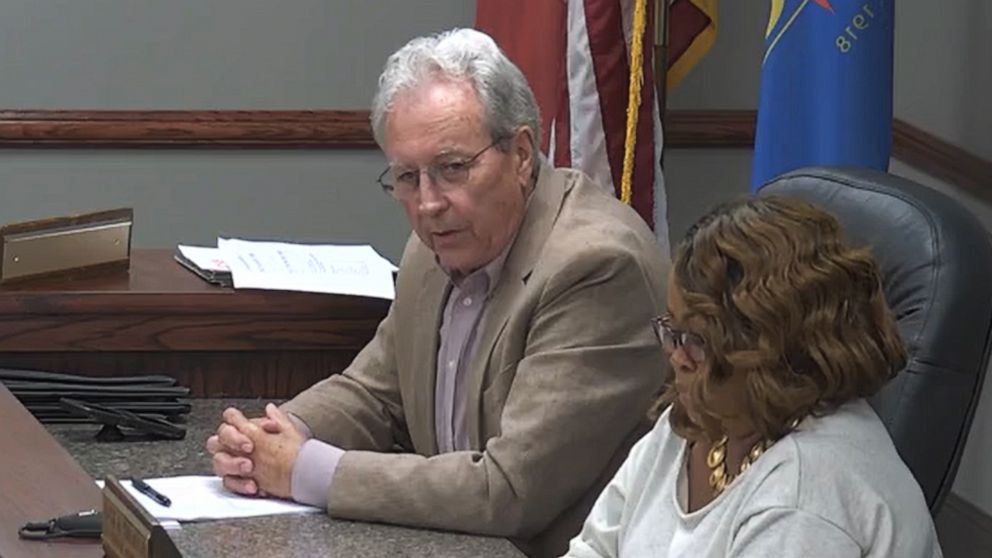
My first thought about Tarrant County councilman Tommy Bryant using the n-word this noxiously –“Do we have a house (n-word) in here”–was that he was reaching back to slavery to express his contempt for the black women on the city council. In her Black Feminist Thought, Patricia Hill Collins emphasizes the extent to which controlling images of black women like the “mammy” and the “jezebel” reach back to the slave period. The same is the case with language like the n-word. One of my favorite Morehead State (KY) students observed some time ago that whites had retreated from segregation only as much as they had to. The same is the case with the language of slavery as well.

No doubt Bryant was reaching back. As MSNBC anchor Joy Reid observed on twitter. Bryant seemed comfortable with the language of racial smears. “It’s how easily the word rolls off his tongue… clearly he puts it to frequent use…”

But there’s also a contemporary context. Bryant’s on the city council of Tarrant, AL with two Black women and serving along a Black mayor. Given its 53% black population, Bryant is “forced” to recognize black people as having an authority that’s at least equal if not greater than his. In this context, Bryant’s outburst might be seen as a scream of pain against the black authority in his life and Bryant himself saw it in terms of attacking Mayor Wayman Newton.

Public discourse ignores the extent and significance of both black moral and political authority and white conservative panic over black authority. If there is a historical touchstone of moral authority in American society, it is Martin Luther King and the Black Civil Rights Movement of the 1950’s and 1960’s. That’s not just the case for Black Americans or whites on the center-left, it’s also the case with white conservatives who use King’s “I Have a Dream” speech as the anchor point for their arguments for a “color-blind” ideal. As he was dying, the late John Lewis became an American icon because his suffering a cracked skull during the Selma March made him an embodiment of the suffering and accomplishment of the Civil Rights Era. Other historical figures of moral authority include Rosa Parks, Frederick Douglass, and W.E.B. DuBois while a moral authority also exemplified by Barack Obama, Michelle Obama, LeBron James, Colin Kaepernick, and Black Lives Matter protesters in the present.

A very long book could be written on the presence of black authority in American society. Let me just say that black authority has more than enough of a presence to cause disorientation and panic among white racists like Tommy Bryant and that this kind of racial panic is one of the motivations behind the rise of Trumpism, conspiracy theories, and white nationalist insurrection. Many white conservatives would rather withdraw from society, fall seriously ill, or die than live in a place with as much black authority as can now be seen in the United States.

White Conservatism and Child Sacrifice

White conservatives in the State of Tennessee are now triggering a large-scale, ritualistic sacrifice of their own children. The relevant event is an edict by the Tennessee Department of Health to suspend communications concerning childhood and adolescent vaccines. From the Tennessean:

The Tennessee Department of Health will halt all adolescent vaccine outreach – not just for coronavirus, but all diseases – amid pressure from Republican state lawmakers, according to an internal report and agency emails obtained by the Tennessean. If the health department must issue any information about vaccines, staff are instructed to strip the agency logo off the documents.

The rationalizations from the Department of Health seem to be that Tennessee wants to stress the authority of (white conservative) parents in relation to vaccinations and that the public health authorities avoid attacks from the right-wing media apparatus.

But there’s something more archaic going on. Republican state lawmakers, conservative media types, and religious leaders are all aware of the statistics on Covid and equally aware that a percentage of children would become seriously ill or die from diseases like hepatitis, rubella, whooping cough, measles, mumps, chicken pox, and polio.

The areas of concern span much farther than just the COVID-19 vaccine, though. The new TDH policy applies to all vaccines — even common childhood vaccines such as Chicken Pox, Measles, Mumps, Polio, and even hepatitis.

What it gets down to is that white conservatives in Tennessee are not only willing but INSIST on a percentage of their children being sacrificed. Of course, human sacrifice has a long history in Western culture. Agamemnon’s sacrifice of his daughter Iphigenia to change the winds was part of the Homeric saga of the Trojan War, written anew in Classical Greece by poets like Euripides, and re-staged recently in “Troy: Fall of a City.” However, the champions of child sacrifice around the ancient Mediterranean appear to be the Carthaginians who practiced child sacrifice on a massive scale right up to the final conquest by Rome in 146bce.

There was a peculiar dualism in Carthage . . . in which the thrust for commerce, prosperity and the good life were blended with a religion so intense that the richest Carthaginian could cheerfully consign a son or daughter to the flames of the sacrificial pit to redeem a pledge to the gods.”

What’s different about Tennessee conservatives (really white conservatives in general) is that the Carthaginians sacrificed their children to propitiate the gods while Tennessee conservatives are setting up the sacrifice more as a PROTEST against public health as am emblem of science as an element of the emergence of the United States as a multicultural, socially liberal, and secular society. Conservatives in Tennessee are so deeply offended by all of these developments that they’re willing to see their kids die rather than cooperate in science-based vaccination.

Keeping Out the Mainstream

What conservatives are smearing as Critical Race Theory is mostly just the civil rights perspectives that have long been mainstreamed into American society. In the final analysis, Laura Ingraham and other white conservatives are objecting to children being taught the underlying perspectives and values of mainstream America.

Luis M Alvarez/AP

LAURA INGRAHAM (HOST): “Universal pre-K is also in the bill. I’m all for educating our youth, but really educating them, not brainwashing toddlers with racist drivel. You think that can’t happen in preschool? Guess again.”

Taking Down Conservative Honor

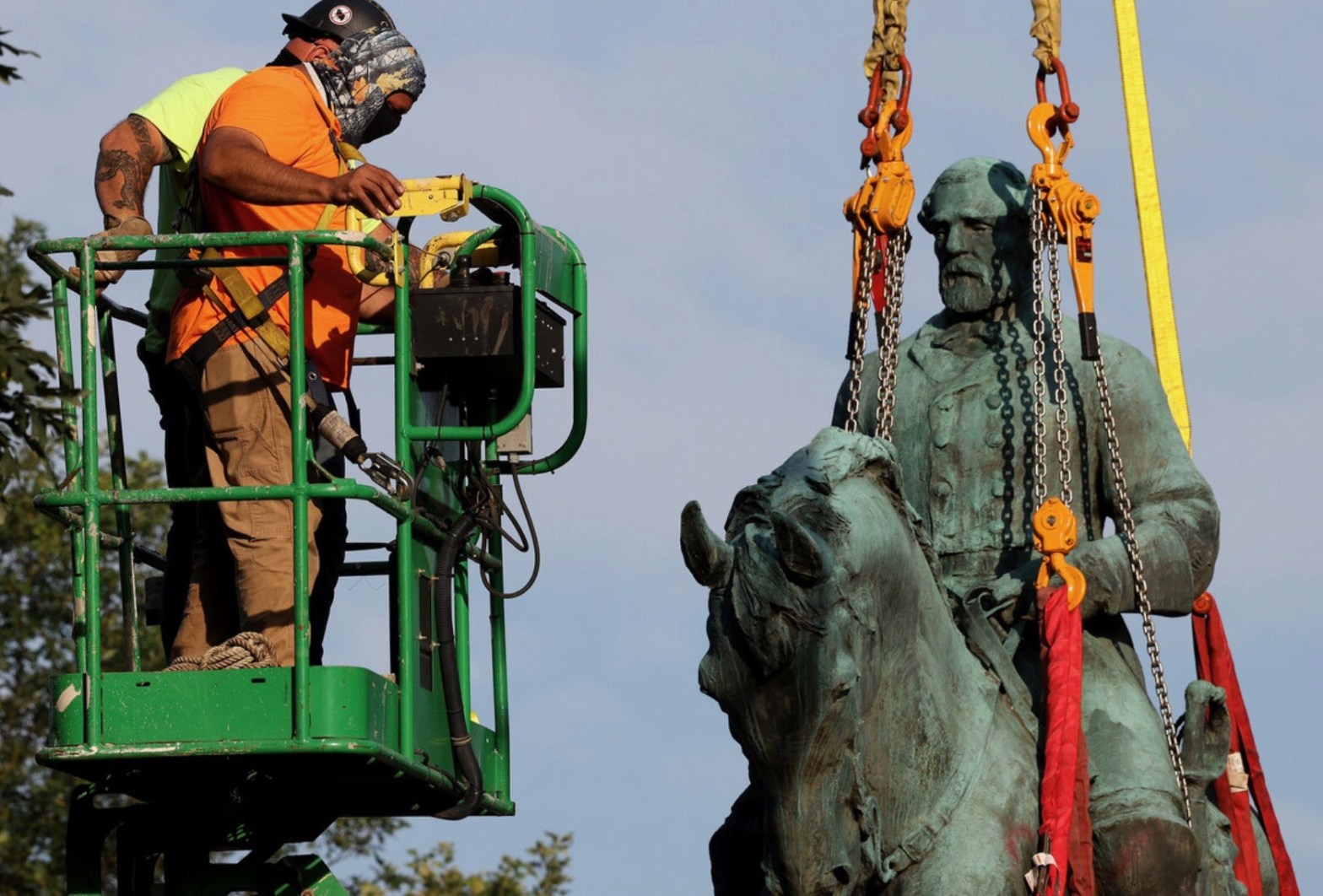
White people aren’t being replaced by immigrants, but symbols of conservative historical honor are being replaced by MLK’s Birthday, Juneteenth, Black History Month, and the 100th anniversary of the Tulsa Race Massacre. Springing up within our midst is a multicultural official history.

Another example of what’s replacing Confederate statues is the National Memorial for Peace and Justice in Montgomery, Alabama. Here’s the exhibit commemorating the victims of lynching in the United States.

Decentering Whiteness Narrative

In today’s Salon, the excellent Chauncey Devega has an informative interview with Annette Gordon-Reed, a member of the Harvard Law faculty, Pulitzer Prize winner, and America’s most foremost authority on Thomas Jefferson.

The conversation settles on the Jan. 6 Insurrection and the threat white conservative nationalism poses to democracy in the United States. For Gordon-Reed, black people have had a fundamental role in the development of American democracy:

“African Americans have from the very beginning been the people who tried to make the promise of America real. They believed in the words of the Declaration of Independence. African Americans have tried to uphold those words, in the face of other people who did not seem to take those words and the values as seriously as they did. African Americans have long tried to uphold the values of the Declaration and the notion of equality in the 13th, 14th and 15th amendments, which brought Black people into citizenship and represent the idea that people should be treated as equal citizens.

“Equal citizenship” for black people makes the U.S. a “multiracial democracy” in the sense of equal responsibility for the primary Constitutional goals of “a more perfect Union,” “Justice,” “domestic Tranquility,” “the common defense,” the “general Welfare,” and the “Blessings of Liberty.” In striving to uphold the Declaration and the 13th, 14th, and 15th Amendments, the black population has been the primary force for creating multiracial democracy in the U.S. To the contrary, the refusal to recognize black people as having full citizenship meant that the United States was not a democracy at all.

That’s the back story for Gordon-Reed asserting that “we are a young country and we’re an even younger full democracy.” The U.S. did not become a ” full democracy” until black people were recognized nationwide as having the right to vote with the Voting Rights Act of 1965. But if the U.S. did not have democracy from the establishment of the federal government in 1788 to 1965, what kind of government (and society) was there?

In my opinion, the U.S. was a “White Republic” with republican self-government, representative political institutions, and individual liberties AND a system for limiting rights and benefits to prosperous whites while excluding blacks, other non-whites, women, and gay people. In this sense, the Civil Rights Era of the 1950’s and 1960’s set in motion a transition from the White Republic to Multicultural Democracy in the United States. White conservatives could be relatively content with the dismantling of legal segregation and recognition of political rights for African-Americans as long as integration was more tokenism than symptomatic. But conservatives underestimated the changes under way and even underestimated the impact of Barack Obama’s election as the first black president in 2008. But Obama’s defense of Henry Louis Gates, sympathy for Trayvon Martin, position as a black President/celebrity made his “blackness” uncomfortably real for conservatives and sealed in a resentment that went well beyond the Tea Party and Birtherism. As racial resentment dug even more deeply into conservative culture, the Backlash that resulted in Trump really took root.

A note on the Juneteenth holiday. Chauncey DeVega asks Gorden-Reed about the significance of the Juneteenth being made a federal holiday and she responds that it “has the potential of starting a conversation or continuing a conversation, about the issue of slavery and freedom, the nature of emancipation and voting.” This is true enough, but I also believe that the Juneteenth holiday has symbolic and substantive significance as part of the iconography of multicultural, multiracial Democracy in the U.S., and should be seen in relation to the Martin Luther King Birthday holiday, black history month, the observance for the centennial of the Tulsa Race Massacre, George Floyd observances, and the Obamas as a cornerstone of multicultural culture in the U.S.

The Source of Constitutional Legitimacy

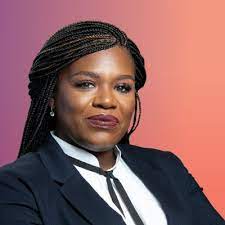
On July 4, Rep. Cori Bush (D-MO) tweeted:” “When they say at the 4th of July is about American freedom, remember this: the freedom they’re referring to is for white people. This land is stolen land and Black people still aren’t free.”

From twitter.com

It took guts for Cori Bush to say this amidst the current backlash, but it’s also the case that few more obvious things have ever been stated. Those who created American government were fond of making universal statements like “We hold these truths to be self-evident, that all men are created equal,” but clearly meant white men and could hardly imagine a society in which which white men lived equally with either women or black people.

Author of the “Declaration of Independence” Thomas Jefferson certainly couldn’t.

Ted Cruz with his usual diplomatic tact, “Hateful divisive lies. The Left Hates America.”

But then Cruz gets conventional and justifies the “Founding Fathers” through reference to black authority. Cruz mainly relies on the 19th century abolitionist leader Frederick Douglass:

I responded with the wisdom of the great abolitionist Frederick Douglass: “Frederick Douglass loved America. He rightly denounced the grotesque evil of slavery, which in 1852 was tragically still legal. But, thanks to the heroic leadership of Douglass & other abolitionists—and a bloody Civil War—we ended that abomination. Douglass closed, “I, therefore, leave off where I began, with hope. While drawing encouragement from ‘the Declaration of Independence,’ the great principles it contains, and the genius of American Institutions, my spirit is also cheered by the obvious tendencies of the age.”

The reference to Douglass is common among conservative defenders of the “Founders,” but why is this the case? Certainly, there is an apparent paradox. The Constitution is viewed as the fundamental law of the land and the statement on all men being equal in the Declaration of Independence is viewed as justifying both the Revolution as the primary foundation of the government created after the Revolution. This is one of the “great principles” from which Frederick Douglass draws encouragement in his famous 4th of July speech in 1852.

Cruz is correct in believing Frederick Douglass approved of the Constitution, but why is Frederick Douglass’ approval needed to justify the Constitution in the first place? My argument is that the authors of the Declaration, the original Constitution, and the Bill of Rights no longer have the credibility needed to legitimize the Constitution themselves. The status of Jefferson, Washington, Madison, Monroe, and others as slaveholders combined with Constitutional measures to protect slavery–delaying the outlawing of the slave trade, the 3/5’s clause, and the Fugitive Slave clause–all implicate the Founders in “the grotesque evil of slavery.” By itself, the founding personalities and documents are delegitimized by slavery and needs a supplemental source or sources of credibility in order to have authority.

As a “great abolitionist,” Frederick Douglass has a credibility grounded in his experience of slavery, escape from slavery, and leadership in the abolitionist movement. Having suffered the worst deprivation of rights authorized by the Founding, Douglass now has a unique credibility to justify the Founding 170 years after his classic speech. How does Douglass justify the Declaration and Constitution?–by interpreting them as applying just as much to black people and women (Douglass also supported women’s suffrage) as they did to white men. The Constitution may be the source of legitimacy for American government but Frederick Douglass is a more important source of legitimacy for the Constitution than any of the leading figures of the Founding Generation.

Learning Lincoln On-line
MLK at Washington Freedom March

But it’s not just Frederick Douglass. Against Cori Bush, Ted Cruz cites Martin Luther King in support of the Constitution and the nation founded on the Constitution.  “And we should be encouraged by Dr. Martin Luther King, Jr.’s exhortation, “The arc of the moral universe is long, but it bends toward justice.” Like Frederick Douglass, Martin Luther King is a black leader who interprets the Constitution and Founding in a way that broadens the notion of freedom and equality in American society.

Of course, Ted Cruz opposes Black civil rights on every level, but is forced by circumstances to draw on the most black leaders to legitimize American society from the founding to the present.