A “dark and wielding” racism

Clay drove home the absurdity of black women wearing fashionable clothing as a reflection on their existential absurdity. Whether shopping for dresses and bonnets, promenading with black men, receiving love letters, or being engaged in casual conversation, black women were “revealed” to be absurd and inferior beings whose only legitimate role might be as a domestic servant. The Black women in Clay’s lithographs had enough money to buy the best in fashionable clothes but the women were so grotesque in their taste and malformed in their bodies that the laughable absurdity of their attempts to wear their fashionable clothes revealed the comic grotesquery of their nature.

For both Black-American women and white women, aspirations to personal independence, equality, and political rights were portrayed as laughable, absurd, or ridiculous.  However, the motivation for the ridicule was different.  White women were ridiculed for aspiring to abandon a “natural” order of society in which they had an honorable set of roles (wives, sisters, daughters) in subordination to men.  If women acted in ways that were deemed appropriate to their roles as wives, mothers, daughters, widows, and seamstresses, they could be viewed as virtuous, amiable, or respectable. Likewise, “feminine” virtues could be seen as fundamental to the functioning of society. To the contrary, Black women were viewed as naturally “subordinate” but not as having a “place” in society that could be viewed as virtuous, honest, or contributing to the common good. Even though Black women were forced into servile roles as domestic servants, they were not seen as naturally “fitting” into those roles or portrayed as fitting into “society.”  In several Clay lithographs, blacks were represented as dressing with exaggerated “inappropriateness,” but black impropriety was not in relation to any kind of appropriate status.  For free blacks in Philadelphia, existence was impropriety.    
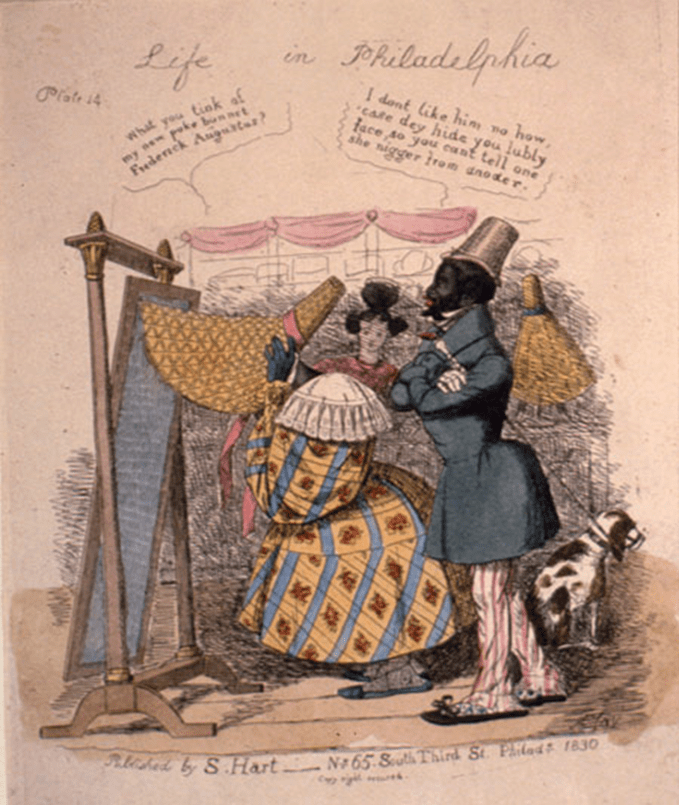
In Plate 14 above, the unnamed Black woman in the picture was wearing the same kind of absurdly large dress as “Chloe” in Plate 4 and having just as large a figure as “Chloe” from the previous engraving. In trying on an grotesque “poke bonnet,” the Black Woman with the bonnet had the same kind of problem as Chloe. As a woman with an exaggerated black body, the Black woman with the bonnet did not have either the physique or the taste to look anything but inappropriate. Indeed, the bonnet was even larger for her head than her dress was for the rest of her body. The front of the bonnet protruded so far beyond her face that her companion “Caesar Augustus” complained about not being able to see her face. At the same time, the rear end of the bonnet had a horn-like shape that was reminiscent of a horn of plenty but also had phallic connotations. There were more phallic connotations with her feet which were extremely large in her blue slippers. The back part of the Black woman’s heel also extending backwards in an unusual and grotesque manner. Stereotypes of black women’s feet, and especially their heels, as elongated in humorous ways were common among the blackface acts of the late 1830’s and blackface bands of the mid and later 1840’s. However, the stereotype of black women having misshapen feet and heels was already current when Clay did his lithographs. In the art of Edward W. Clay, the phallic images of elongated feet and the base of the over-sized bonnet combined with the woman’s blocky figure and inappropriate dress to give her a misshapen body and a complete lack of common sense. For all the genteel affect of the woman with the bonnet, she was represented as incapable of performing basic functions like dressing herself or buying clothes. She was somebody with no place in society and Caesar Augustus spoke for the white community by using a racist putdown. In the opinion of her companion “Caesar Augustus,” these kinds of bonnets hid the faces of Black women to such an extent that “you can’t tell one she-nigger from another.”


Comic Substance and the Clay Lithographs

In my chapter on “Jim Crow and Marginal Performers,” I have a draft on the Jim Crow section and am preparing to start writing on the Edward W. Clay Lithographs at the Library Company of Philadelphia and Library of Congress. in 1828, Clay was a 30 year old lawyer who was making a transition to being a full-time engraver and artist. His “Life in Philadelphia” series has been viewed as a “satire” on black aspirations and Plate 4 of an exchange between “Caesar” and “Chloe,” “Chloe’s” answerer that she “aspires” too much to a question about the weather is seen as a prototypical example of Clay’s approach.

However, Clay’s lithographs have much more significance than satire. Concerning Clay, my argument is that Clay portrays black men and women in terms of being “comic substance,” that the stereotypes in Clay’s work formed part of the “discourse on blackness” that informed the reception to Rice’s portrayal of “Jim Crow” in the early 1830,” and that Clay’s representation of “blackness” was more influential on the blackface minstrelsy of the late 1830’s and early 1840’s than that of Rice.

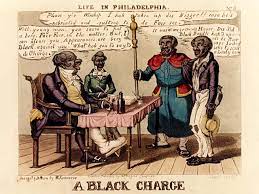
In the drawing of the conversation between “Caesar” and “Chloe” above, “Chloe” is pictured as a dark-skinned black woman with an exceedingly large, block-like figure rendered absurd by the apparatus of genteel femininity, including her oversized dress, enormous hat, veil, fan, and parasol, her largeness accentuated by Clay’s making her slightly bigger than “Caesar.” These two signifiers of Chloe’s “blackness” mirrored each other in a way that enhanced both the grotesqueness of her body and the absurdity of her attempts at genteel fashion. Chloe’s absurdity was heightened even further by her “African” malapropism of “I aspire too much.” She may have had the genteel ambitions that can be seen through her wardrobe, but Chloe’s size, clothes, and speech all signified her as a combination of black and an out of place figure of absurdity. Chloe was far from being a lady, but her genteel ambitions disqualified her from being a domestic servant, shopkeeper, bar maid, or any other position in society. Having no other place in the world except her highly magnified blackness, Chloe was represented as a comic substance existing entirely for the amusement of white people. In this sense, the figure of Chloe embodies a kind of slave state where her reason for existing was serving the purposes of white people. Outside the purposes of white people, the figure of Chloe had no place in society.

Edward W. Clay produced fourteen plates in his “Life in Philadelphia” series. Where T. D. Rice represented “Jim Crow” as “degraded” in his black skin, hair, dialect, and poverty, Clay imparted more racially degrading content into his image of blackness. Clay did not just assume that his audience would recognize blackness as degraded, he portrayed that degradation in terms of black people of having no real place in Philadelphia society and existing as a “comic substance.” Clay published the “Life in Philadelphia” series two years before Rice made his first appearance as “Jim Crow” and four years before Rice arrived for his first performances in Philadelphia. To the extent that Clay’s representation of blackness as a comic substance of over-sized bodies, social homelessness, and ridiculous lack of common sense characterized Philadelphia audiences, the appropriation of blackness by Rice and his audience was an even more profound cultural act than was indicated by the “Jim Crow” songs and performances. If “blackness” was understood as more deeply degraded, the identification with blackness involved even more than Rice may have understood.

Make Pride a National Holiday

Florida Gov. Ron DeSantis ordered Jacksonville to stop lighting up the bridge but #Pride is a patriotic celebration of #LBGT communities and the multicultural, inclusive character of American society. The June 28 anniversary of the Stonewall Riot should be a federal holiday.

And Juneteenth is just around the corner.

Abortion Rights and an Emerging Super-Majority

Matt Lewis of The Daily Beast argues that Democrats need to “win the substantive arguments” rather than keep trying to pressure Joe Manchin into voting to blow up the filibuster.

But that’s already the case.

The Democrats have already won most of the arguments and are on the verge of forming an electoral super-majority.

To give one example, the Pew Research Center recently found that abortion rights are supported by 59% of the public and opposed by only 39%. That’s a 2-1 margin in favor of abortion rights. With all the effort conservatives put into making abortion controversial, the left is still winning the battle of public opinion.

If American institutions were operating in a functional manner, there would be more federal, state, and judicial action to protect and expand abortion rights.

But the Republican Party has found ways to keep super-majority opinion from being enacted into law. To the extent that Republicans still care about working through the American constitutional system, blocking the super-majority is now their main objective.

Conservatives Losing History

June is Pride Month but LGBT recognitions and celebrations both disgust cultural conservatives like Rod Dreher and give them a sense of hopelessness–“doesn’t it seem to you like every month is Pride Month.”

I imagine Dreher is equally as disappointed by the centennial observance of the Tulsa Race massacre of 1921. Every month has become Black History as well.

And Juneteenth is just around the corner.

Speaking of black history, Juneteenth is right around the corner.

A Terrorist Ideology

Asha Rangappa of CNN gets to the heart of the matter. The Big Lie that the 2020 election was stolen from Trump has become a terrorist justification for overthrowing American government. a rallying point for right-wing extremism, and a unified narrative for all the militia and paramilitary groups, conspiracy theories, and anti-abortion zealots. Given that polling finds that more than half of Republican voters believe that Donald Trump is the actual president, The Big Lie also creates a large pool of people who already believe the Biden Administration is an illegitimate government.

Condensed Thoughts on 1619 Project

Last Weekend, there was enough debate about the 1619 Project that I wanted to put together some of my basic thoughts.

  1. Perspective. The ultimate significance of the #1619 Project is that it replaces the “Founding Fathers” with Black American history as the center of the American national narrative.
  2. Nikole Hannah-Jones sketches out a history of the Middle Passage, slavery, Reconstruction, and the Civil Rights movement as the primary current of democratic progress in the U.S. Working from a multicultural premise, black leaders and black culture worked out a more effective concept of universal liberty than the white authors of the Declaration of Independence and Constitution.
  3. An Objection: Hannah-Jones portrays Black Americans as “perfecting” an American Democracy which can be seen in the Constitution in a form distorted by slavery and white supremacy. To the contrary, the 18th century founding of the U.S. established a “White Republic” and the current political crisis can be seen in terms of a determined backlash against the transition to a multiracial and socially liberal democracy.
  4. Necessity. For political and cultural reasons, the history of black people in the U.S. needs to be seen as the backbone of multiracial, socially liberal democracy.
  5. Permutations.  Hannah-Jones writes about the way in which the Black Civil Rights Movement provided a model and impetus for other populations. “But the laws born out of black resistance guarantee the franchise for all and ban discrimination based not just on race but on gender, nationality, religion and ability.” Indeed, campaigns for feminism and the rights of LGBT, immigrants, natives, and the disabled have all been permutations of the Black Civil Rights Movement.

Further Thought on Black “Otherness”

I am still focused on the ways in which whites view black people as “the other.” Once again, this is highly concentrated and written without much context.

1. Before the 1830’s, whites in Philadelphia were very reluctant to portray blacks as “the other” because they refused to recognize blacks as having enough status to engage in “self-other” relationships. Doing so would recognize black people as part of “society” and that was a basic gesture of respect whites refused to extent.

2. With the “Jim Crow” act of T.D. Rice, whites articulated a full concept of black otherness based primarily on the fantasies of blackness articulated by Rice and other minstrel performers. Whites consumed and internalized a commercially developed “fantasy of blackness” from blackface minstrelsy and then opposed themselves as “the self” to that (fantasized) black “other.”

3. Given the internalization of such fantasies of blackness, white people experienced the racial self-other opposition primarily as a dimension of white self-awareness and only secondarily in relation to any contact they had with black people in the social world. This created a number of complications because whites insisted of the realism of blackface fantasy in opposition to the realities of their encounters with black people

According to W.E.B. DuBois, The Souls of Black Folk, ” the Negro is a sort of seventh son, born with a veil, and gifted with second-sight in this American world,—a world which yields him no true self-consciousness . . . ” But early blackface makes it necessary to reconsider this pronouncement. Given that early blackface minstrelsy created a white identity predicated on fantasies of blackness, it may have been that the white world was itself so heavily veiled that it was unknowable to both black people and white people themsleves.

4. During the mid-1830’s and early 1840’s, the minstrel performers who emerged after Rice deployed racial stereotypes in a way that defined “blackness” as a form of “comic substance.” On top of the “Jump Jim Crow” images of black skin, dialect, poverty and hair, the newer minstrel performers developed images of misshapen and absurdly phallic black hair, noses, lips, feet, and heels. For performers like J.W. Sweeney (pictured above), black people were the “other” in the sense of being a fantasy of comic substance.

5. White popular culture accompanied the fantasy of blacks as “comic substance” with an idea of enjoying the suffering of black people from disease, death, dismemberment, grief, and being sold further South. Laughter had always been a dimension of blackface, but the laugher took on even more of a leering, sadistic quality once black otherness was conceived in terms of comic substance.

6. With black otherness being defined as comic substance, the enjoyment of black suffering a primary mode of bonding and group solidarity in white popular culture. There were many ways in which being white was contingent on enjoying the suffering of black people.

Rep. Andrew Clyde: Insurrectionist Ally

Rep. Andrew Clyde (R-GA) wasn’t just lying “about” the Jan. 6 Insurrection, he was lying on “behalf” of the Insurrection. One of the main questions about the Insurrection is the extent to which it was supported by the 147 House Republicans who voted against approving the election of Joe Biden. By lying in this kind of egregious way, Rep. Clyde is outing himself as an insurrectionist ally.

Photo by J. Durkin

No One Debating Marjorie

Marjorie Taylor Greene’s major function in Congress is wasting everyone’s time with procedural motions. But yesterday Greene also tried to bully Rep. Alexandria Cortez-Ocasio by yelling at her about supporting Black Lives Matter and Antifa and especially about AOC’s refusal to debate her about the Green New Deal.

Greene’s problem goes beyond her support for QAnon and supporting calls to execute Nancy Pelosi. Since Trump’s election in 2016, leftie/liberal attitudes toward conservative have changed from “condescension” to “contempt” and people on the center-left are no longer willing to debate conservatives on economic policy, abortion rights, trans rights, or any other kind of political or cultural issue.

That represents an enormous shift among white Americans. Political debate used to form a common ground between liberals and conservatives.

But that common ground disappeared.