They Might Have Been Normies

Living in fear and unemployable: Far-right extremists are finding themselves doxed and out of work
Screensgrabs, Unidentified far right activists

The Washington Post has an interesting and telling story on left-wing doxing of far-right activists such as Edward Jeremy Dawson and his wife Michelle Dawson.

The Story: While at the “Million Maga” March on Nov. 14, 2020, Edward Dawson stepped on the feet of left activist photographer Laura Jedeed. Their ensuing argument attracted a crowd of far right marchers and the incident escalated to the point where Jedeed was in danger of being violent assaulted. Recognizing that the bullying of Jedeed had gone farther then he wanted, Dawson then led her through the crowd to safety. After Jedeed’s video of the incident went viral, Edward Dawson was fired from his job as an iron worker. His wife Michelle also lost her job with Walmart and believes her activism was the reason for being fired as well.

The Undertow: The Washington Post story was primarily about the doxing on the left which led to the Dawsons getting fired from their jobs. Other than anti-fascist activist Christian Exoo working at my old college St. Lawrence University that was not so interesting. There were other themes though.

Montagues and Capulets: The violence between anti-Nazis and right-wing extremists is taking on Shakespearean dimensions in Portland. That’s especially true on the right where the Dawsons were members of Patriot Prayer, a group dedicated primarily to “”trolling” the Pacific Northwest with the intention of provoking a response from far-left antifascists.” Attending gatherings with the Oathkeepers, Three Percenters, and Proud Boys, the Patriot Prayer group seemed more intendant on brawling with antifa activists than anything else. Far from making them less dangerous, the radicalism of Patriot Prayer members like the Dawsons had a violence for its own sake feel to it. As Edward Dawson said of his bullying and harassment of Jedeen, “I mean, I wasn’t harassing anyone. I just wanted to make her feel just a little bit scared.”

The Non-Elite of the Left Behind: In an interview with Salon’s Chauncey Devega, sociologist Arlie Hochschild calls Jan. 6 Insurrectionists the “Elite of the Left Behind.” The Dawsons are more the working class/lumpen proletariat of the Left Behind. Edward and Michelle Dawson both dropped out of high school and Edward had been a drug addict who served six years in prison for felony possession of a controlled substance. Edward Dawson “got clean” in prison and claims to have cut off ties to the drug life before getting married, buying a house, becoming a father, and holding a job as an iron worker. But it does not appear that living as a “normie” working citizen and wasn’t enough and that Edward and Michelle Dawson found a larger purpose in Trump and extreme right-wing activism. She was emphatic about Patriot Prayer leader Joey Gibson: “He talked a lot about freedom and God . . . I’ve seen his fire and I’ve seen that he had a voice and he wasn’t afraid to use it.” Michelle Dawson can’t bring herself to love a multicultural, socially liberal democracy but loved Trump. “I like everything that Trump stood for . . . I loved how he loved our country.”

Now or Never: Like everyone else, I have no idea of how the present national crisis will work out in the U.S. But there is some anecdotal evidence of the violent extreme right being culturally ephemeral. Jan. 6 insurrectionist Guy Reffitt was reported to the FBI by his own son who not only supported Black Lives Matter but attended at least one BLM rally in the Dallas area. With the Dawson’s, one of their children saw nothing wrong with her father’s bullying and harassment of Laura Jedeed but Michelle Dawson reported that an 18 year old daughter was disgusted with her: “But she’s 18, so she’s all, ‘Orange man is bad. George Floyd shouldn’t have died. Blah, blah, blah.’ She hates what I do.”

If extreme right wingers can’t get their own kids behind them, it may be now or never for them.

The Second Amendment and Terrorism

Talking Points Memo has an account of James Dale Reed’s guilty plea for threatening President Joe Biden, VP Kamala Harris, and neighboring Democratic voters last October. In a letter to his neighbors, Reed wrote:

If you are a Biden/Harris supporter you will be targeted. We have a list of homes and addresses by your election signs. We are the ones with those scary guns. We are the ones your children have nightmares about . . .”

Now as for Grandpa Biden and Mrs. Harris, when we capture Grandpa Biden we will severely beat him to the point of death,” the letter reads, before going on to describe a graphic threat to Harris. “then every Biden/Harris supporter will understand what the 2nd amendment is all about,” the letter reads, included in a sworn statement from a Secret Service agent investigating the case

Matt Gaetz recently made waves by claiming that the 2nd Amendment is about “the ability to maintain an armed rebellion against the government if that becomes necessary.” But James Dale Reed expresses the terrorist element in the Trump movement and Republican Party even better when he treats the Second Amendment as a reason and justification for murdering his neighbors in Frederick, MD.

Second Amendment terrorism might be the next logical step for white nationalist terrorists in the Trump movement.

Juneteenth and the Weight of Slavery

I246 years. Nearly two and a half centuries. That is how long enslavement lasted in what is now the United States of America. Twelve generations of enslavement on this soil. Twelve generations of human beings who were each condemned to work for the right to live another day. This came to be my distillation of what slavery was, as I worked to try to quantify the magnitude of the damage done by slavery in America: Twelve generations of mothers and fathers and children born with no hope of seeing freedom in the Land of the Free, no visible ceiling to the lineage of suffering. How many “greats” would we have to add to the word “grandparent” to begin to comprehend how long slavery lasted on this soil? It was not until two and a half years after the Emancipation Proclamation and months after the end of the Civil War that, on June 19, 1865, word finally reached the last of the enslaved Americans that “all slaves are free.” Union General Gordon Granger read these words, directed toward recalcitrant slaveholders, from the balcony of the former Confederate Army headquarters in Galveston, Texas. The newly liberated people would come to call this day Juneteenth.Here, survivors of slavery soberly observe Juneteenth in their hats, canes and bonnets in Austin, TX, 1900. In the early years, the newly freed people and their descendants took pains to dress up for Juneteenth, as laws had forbidden slaves from dressing “above their station,” above their caste. Today, as we commemorate Juneteenth, let us remember that slavery was not merely a sad, dark chapter in our country’s history, but the foundation of the country’s social, political and economic order, and that it lasted for nearly a quarter of a millennium.— Caste: The Origins of Our Discontents www.isabelwilkerson.com

This passage from Isabel Wilkerson’s facebook account captures a dimension of Juneteenth celebration that is worth further comment. In Wilkerson’s account, the meaning of Juneteenth is not captured entirely or even primarily by the liberation from slavery or even the destruction of the slave system as a result of the Civil War.

PublicReviewDomain.org

Instead, it’s the weight of slavery itself: the duration across “twelve generations,” the vulnerability of not knowing whether an enslaved person would live or die at any day, the despair of not being able to hope for freedom. And that’s not to mention the horrors of the middle passage, the spectacle of the coffles of black men and women being force marched to the plantations of the South, the grief of family separation, the trauma of being tortured, whipped, raped, and seeing these cruelties inflicted on mothers, fathers, sisters, brothers, friends, and everyone else within the range of an enslaved person’s acquaintance. Isabel Wilkerson writes that slavery was “the foundation of the country’s social, political and economic order” and it follows that Juneteenth will be fundamental to this country’s self-understanding because slavery itself was the “foundation” of our national existence.

By commemorating the end of slavery, the Juneteeenth celebration further clarifies the weight of slavery on black Americans as a focus of America’s historical heritage and national identity. Indeed, it’s not hard to see that weight becoming an element in other national celebrations as well.

Clay Lithographs: Adding Men to the Mix

In his pictures of Black men, Clay uses racial stereotypes to signify blackness as degraded and animalistic while also employing a language of “blackness” to demean black people.

In the case of the man at the cellar door, his pretensions to gentility are mocked by his attempt at courtship. The man is dressed as a gentleman with a blue coat, top hat, and a cane and formally addresses a servant when he asks “Is Miss Dina at home?” The appearance of gentility is already subverted when the man asks for a “Miss Dina” which marks the object of his attraction as a black woman. The appearance becomes farcical when “Miss Dina” is revealed as a domestic servant “potickly engaged in washing de dishes.” The lesson of the lithograph is that gentility on the part of black men is strictly a pretense and that black men are just as much servants by nature as “Dina.” By substituting the African dialect of “potickly” for the term “particularly,” the servant opens to door for malapropisms signifying her blackness and the Man at the Cellar Door regrets that he “cant have the honour to pay my devours to her” before leaving his card.

The Clay lithographs had a variety of ways to represent the “blackness” of black men in terms of being misshapen and animalistic. With the man at the cellar door, Clay portrays him as having enlarged and rounded buttocks. In the exchange between Caesar and Chloe on Plate 4, “Caesar” is not only represented as short but as having a body that resembles a chimpanzee in the way it is short with a thick chest, shoulders and arms with a small waist.

Library Company of Philadelphia

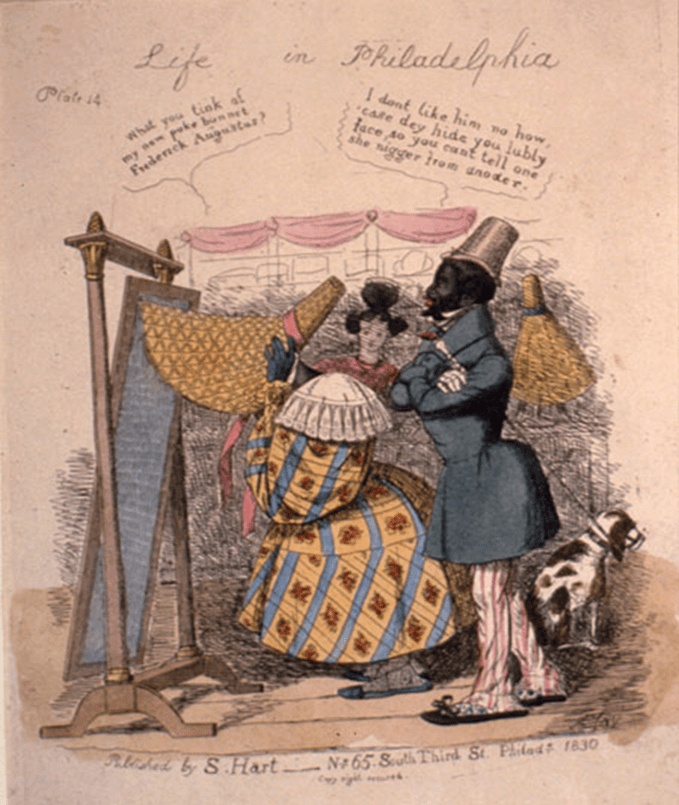
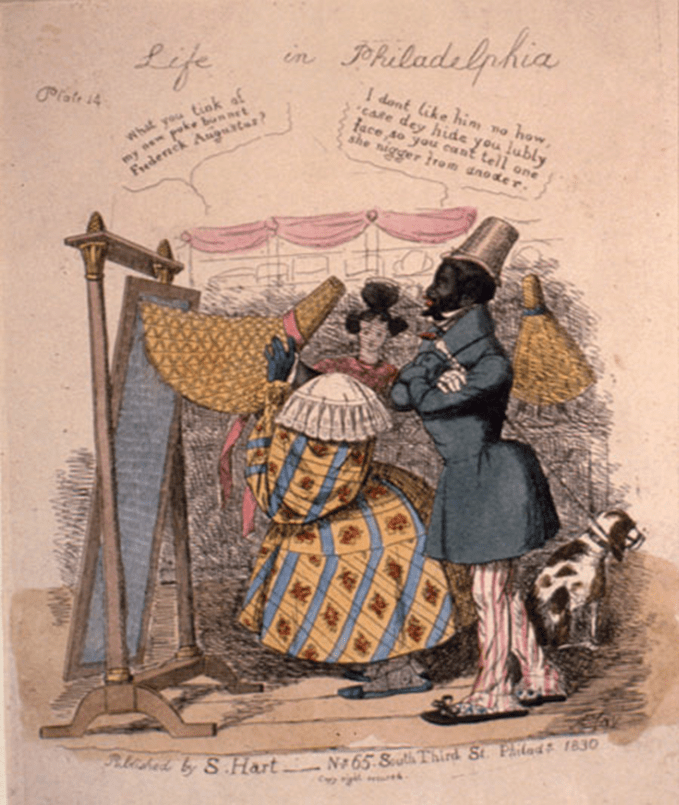
In the picture of the woman trying on the poke bonnet, Clay portrays “Frederick Augustus as having such an enlarged backside that it looked like Clay drew a pillow back there. At the same time, Clay gave “Frederick Augustus” a facial shape, beard, lips, and hair that had an ape-like appearance. In this sense, Clay was not just ridiculing the aspirations of Frederick Augustus and Caesar to the genteel status advertised by their clothes, he was portraying them as a kind of monstrous combination of the human and animal with genteel pretension giving the concoction a particular absurdity. The black men in Clay’s pictures had money and taste, but their monstrous blackness meant that they had no real place in either the human or animal kingdom. Even Frederick’s dog turns away from him.

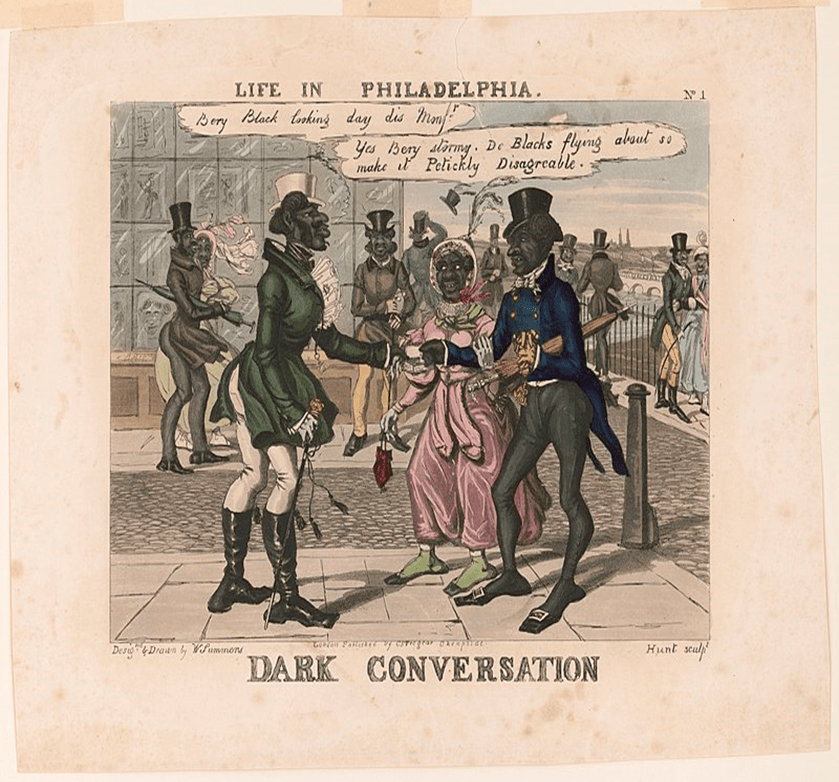
With the "Dark Conversation" picture, Clay brings together several of his themes concerning black men. All the men in Dark Conversation have a genteel affect of top hats, waist coats, gentleman's trousers, and umbrellas. The man in the green jacket is wearing boots and carrying a crop for riding horses. But most of the men in "Dark Conversation" have the same rounded buttocks as the man in the cellar door and Frederick Augustus with the absurdity enhanced by the group effect of having several black men in the picture. As was the case with T.D. Rice and Jim Crow, the rounded buttocks were a stereotype of blackness, but Clay added to the half human connotations of blackness by giving almost all of the men extra large feet with heels extending well to the rear. The men conversing with each other each has ridiculously large feet that extend far out of both the front and the back. In this sense, Clay's lithographs portray black men and black women as being monstrosity of nature as well as ridiculous in their aspirations for upward mobility.

In “Dark Conversation,” Edward W. Clay also began using the term “black” as a way to demean black men and women. The set up for Clay’s joke was the man in the green jacket saying “berry black looking day this” with the man in the blue answering that “the blacks flying around so make it polikly disagreeable.” Along the same line, Clay’s “The New Shoes, has a black shoemaker admit that black is “not handsome to look at” when a black woman asks for pink or white shoes because black “is such a berry dirty color.” The power of the humor lay particularly in Clay’s putting his own demeaning of black people in the mouth of a black man. From Clay’s point of view, his portrayals of black people as misshapen misfits were enhanced by attributing them to black men and women.

A “dark and wielding” racism

Clay drove home the absurdity of black women wearing fashionable clothing as a reflection on their existential absurdity. Whether shopping for dresses and bonnets, promenading with black men, receiving love letters, or being engaged in casual conversation, black women were “revealed” to be absurd and inferior beings whose only legitimate role might be as a domestic servant. The Black women in Clay’s lithographs had enough money to buy the best in fashionable clothes but the women were so grotesque in their taste and malformed in their bodies that the laughable absurdity of their attempts to wear their fashionable clothes revealed the comic grotesquery of their nature.

For both Black-American women and white women, aspirations to personal independence, equality, and political rights were portrayed as laughable, absurd, or ridiculous.  However, the motivation for the ridicule was different.  White women were ridiculed for aspiring to abandon a “natural” order of society in which they had an honorable set of roles (wives, sisters, daughters) in subordination to men.  If women acted in ways that were deemed appropriate to their roles as wives, mothers, daughters, widows, and seamstresses, they could be viewed as virtuous, amiable, or respectable. Likewise, “feminine” virtues could be seen as fundamental to the functioning of society. To the contrary, Black women were viewed as naturally “subordinate” but not as having a “place” in society that could be viewed as virtuous, honest, or contributing to the common good. Even though Black women were forced into servile roles as domestic servants, they were not seen as naturally “fitting” into those roles or portrayed as fitting into “society.”  In several Clay lithographs, blacks were represented as dressing with exaggerated “inappropriateness,” but black impropriety was not in relation to any kind of appropriate status.  For free blacks in Philadelphia, existence was impropriety.    

In Plate 14 above, the unnamed Black woman in the picture was wearing the same kind of absurdly large dress as “Chloe” in Plate 4 and having just as large a figure as “Chloe” from the previous engraving. In trying on an grotesque “poke bonnet,” the Black Woman with the bonnet had the same kind of problem as Chloe. As a woman with an exaggerated black body, the Black woman with the bonnet did not have either the physique or the taste to look anything but inappropriate. Indeed, the bonnet was even larger for her head than her dress was for the rest of her body. The front of the bonnet protruded so far beyond her face that her companion “Caesar Augustus” complained about not being able to see her face. At the same time, the rear end of the bonnet had a horn-like shape that was reminiscent of a horn of plenty but also had phallic connotations. There were more phallic connotations with her feet which were extremely large in her blue slippers. The back part of the Black woman’s heel also extending backwards in an unusual and grotesque manner. Stereotypes of black women’s feet, and especially their heels, as elongated in humorous ways were common among the blackface acts of the late 1830’s and blackface bands of the mid and later 1840’s. However, the stereotype of black women having misshapen feet and heels was already current when Clay did his lithographs. In the art of Edward W. Clay, the phallic images of elongated feet and the base of the over-sized bonnet combined with the woman’s blocky figure and inappropriate dress to give her a misshapen body and a complete lack of common sense. For all the genteel affect of the woman with the bonnet, she was represented as incapable of performing basic functions like dressing herself or buying clothes. She was somebody with no place in society and Caesar Augustus spoke for the white community by using a racist putdown. In the opinion of her companion “Caesar Augustus,” these kinds of bonnets hid the faces of Black women to such an extent that “you can’t tell one she-nigger from another.”

Comic Substance and the Clay Lithographs

In my chapter on “Jim Crow and Marginal Performers,” I have a draft on the Jim Crow section and am preparing to start writing on the Edward W. Clay Lithographs at the Library Company of Philadelphia and Library of Congress. in 1828, Clay was a 30 year old lawyer who was making a transition to being a full-time engraver and artist. His “Life in Philadelphia” series has been viewed as a “satire” on black aspirations and Plate 4 of an exchange between “Caesar” and “Chloe,” “Chloe’s” answerer that she “aspires” too much to a question about the weather is seen as a prototypical example of Clay’s approach.

However, Clay’s lithographs have much more significance than satire. Concerning Clay, my argument is that Clay portrays black men and women in terms of being “comic substance,” that the stereotypes in Clay’s work formed part of the “discourse on blackness” that informed the reception to Rice’s portrayal of “Jim Crow” in the early 1830,” and that Clay’s representation of “blackness” was more influential on the blackface minstrelsy of the late 1830’s and early 1840’s than that of Rice.

In the drawing of the conversation between “Caesar” and “Chloe” above, “Chloe” is pictured as a dark-skinned black woman with an exceedingly large, block-like figure rendered absurd by the apparatus of genteel femininity, including her oversized dress, enormous hat, veil, fan, and parasol, her largeness accentuated by Clay’s making her slightly bigger than “Caesar.” These two signifiers of Chloe’s “blackness” mirrored each other in a way that enhanced both the grotesqueness of her body and the absurdity of her attempts at genteel fashion. Chloe’s absurdity was heightened even further by her “African” malapropism of “I aspire too much.” She may have had the genteel ambitions that can be seen through her wardrobe, but Chloe’s size, clothes, and speech all signified her as a combination of black and an out of place figure of absurdity. Chloe was far from being a lady, but her genteel ambitions disqualified her from being a domestic servant, shopkeeper, bar maid, or any other position in society. Having no other place in the world except her highly magnified blackness, Chloe was represented as a comic substance existing entirely for the amusement of white people. In this sense, the figure of Chloe embodies a kind of slave state where her reason for existing was serving the purposes of white people. Outside the purposes of white people, the figure of Chloe had no place in society.

Edward W. Clay produced fourteen plates in his “Life in Philadelphia” series. Where T. D. Rice represented “Jim Crow” as “degraded” in his black skin, hair, dialect, and poverty, Clay imparted more racially degrading content into his image of blackness. Clay did not just assume that his audience would recognize blackness as degraded, he portrayed that degradation in terms of black people of having no real place in Philadelphia society and existing as a “comic substance.” Clay published the “Life in Philadelphia” series two years before Rice made his first appearance as “Jim Crow” and four years before Rice arrived for his first performances in Philadelphia. To the extent that Clay’s representation of blackness as a comic substance of over-sized bodies, social homelessness, and ridiculous lack of common sense characterized Philadelphia audiences, the appropriation of blackness by Rice and his audience was an even more profound cultural act than was indicated by the “Jim Crow” songs and performances. If “blackness” was understood as more deeply degraded, the identification with blackness involved even more than Rice may have understood.

Make Pride a National Holiday

Florida Gov. Ron DeSantis ordered Jacksonville to stop lighting up the bridge but #Pride is a patriotic celebration of #LBGT communities and the multicultural, inclusive character of American society. The June 28 anniversary of the Stonewall Riot should be a federal holiday.

And Juneteenth is just around the corner.

Abortion Rights and an Emerging Super-Majority

Matt Lewis of The Daily Beast argues that Democrats need to “win the substantive arguments” rather than keep trying to pressure Joe Manchin into voting to blow up the filibuster.

But that’s already the case.

The Democrats have already won most of the arguments and are on the verge of forming an electoral super-majority.

To give one example, the Pew Research Center recently found that abortion rights are supported by 59% of the public and opposed by only 39%. That’s a 2-1 margin in favor of abortion rights. With all the effort conservatives put into making abortion controversial, the left is still winning the battle of public opinion.

If American institutions were operating in a functional manner, there would be more federal, state, and judicial action to protect and expand abortion rights.

But the Republican Party has found ways to keep super-majority opinion from being enacted into law. To the extent that Republicans still care about working through the American constitutional system, blocking the super-majority is now their main objective.

Conservatives Losing History

June is Pride Month but LGBT recognitions and celebrations both disgust cultural conservatives like Rod Dreher and give them a sense of hopelessness–“doesn’t it seem to you like every month is Pride Month.”

I imagine Dreher is equally as disappointed by the centennial observance of the Tulsa Race massacre of 1921. Every month has become Black History as well.

And Juneteenth is just around the corner.

Speaking of black history, Juneteenth is right around the corner.

A Terrorist Ideology

Asha Rangappa of CNN gets to the heart of the matter. The Big Lie that the 2020 election was stolen from Trump has become a terrorist justification for overthrowing American government. a rallying point for right-wing extremism, and a unified narrative for all the militia and paramilitary groups, conspiracy theories, and anti-abortion zealots. Given that polling finds that more than half of Republican voters believe that Donald Trump is the actual president, The Big Lie also creates a large pool of people who already believe the Biden Administration is an illegitimate government.