When I started “Writing Early Blackface,” my idea was to write short, snappy, and frequent posts that were not much longer than my twitter contributions.
But that has NOT happened at all!
I became obsessed with synthesizing and the result was that many of my posts are 200-600 word range with “Mysteries of the Democrats” stretching out to 1600. IMHO, “Mysteries of the Democrats” was a quality post and a growth experience to write, but I can’t sustain that kind of writing on a daily basis while also continuing to work on my book manuscript.
So, what I’m going to be shooting for in the future is a mix of short and longish cultural and political takes along with more entries on my efforts to write a book manuscript on the transformation of white population culture in ante-bellum Philadelphia.
These Patriot Front guys look like morons. But last weekend’s “march” is a useful reminder that white nationalist terrorism is the most important national security threat facing the United States.
I bet yesterday was a good day for Lauren Boebert, the gun toting first-term Republican member of the House from Colorado. Over the Thanksgiving recess, Boebert entertained an audience with her account of an interaction with Rep. Ilhan Omar that never took place.
Over the Thanksgiving break, Lauren Boebert said she was recently in a Capitol elevator with Ilhan Omar when a fretful Capitol police officer ran up. Lauren Boebert said: “Well, she doesn’t have a backpack. We should be fine.” Boebert then called Ilhan Omar, “jihad squad.”
The story was a big hit with her bigoted audience, but was leaked which Boebert then took as an opportunity to launch a baiting campaign against Rep. Omar with a tweet apologizing “to anyone in the Muslim community I offended with my comment about Rep. Omar.” Boebert was called into the principal’s office by McCarthy but he seemed to be placated by the apology and Boebert indicating that she wanted to meet with Omar in what McCarthy thought was an effort to put the issue to rest. But Boebert was all about personally baiting Omar at this point. She called Omar and responded to Omar’s demand for an apology with her own demand that Omar apologize for her “anti-American, antisemitic, anti-police rhetoric. ” In other words, Boebert wanted Omar to apologize for Boebert’s own smears of Omar’s policy positions.
At this point everything was good for Boebert. She got in her Islamophobic digs, she wasn’t in trouble with Kevin McCarthy, and she’d offended a prominent member of The Squad enough that Omar hung up on her. For a right-wing extremist who lives for publicity, that’s all winning.
From Boebert’s perspective, it then got better.
Yesterday, Rep. Ilhan Omar held a press conference in which she played a video of a voicemail threat that she received in the course of her dispute with Boebert. The text is below the picture.
Rep. Ilhan Omar (D-MN) plays a horrific death threat she received following Rep. Lauren Boebert’s (R-CO) recent Islamophobic attacks on her.
“We see you, Muslim sand n***** bitch,” the message began. “We know what you’re up to. You’re all about taking over our country. Don’t worry, there’s plenty that will love the opportunity to take you off the face of this fucking earth. Come get it, you fucking Muslim piece of shit. You jihadist. We know what you are. You’re a fucking traitor. You will not live much longer, bitch, I can almost guarantee you that. We the people are rising up, and you will be tried before a military tribunal, and you will be found guilty.”
I have both a lot of sympathy for Rep. Ilhan Omar and much respect for the courage it took to play this. But I also think her response is inadequate to the challenge posed by Boebert and the threatening caller. Rep. Omar’s argument is that Lauren Boebert needs to be held accountable for her bigoted statements against Omar because such statements have “real consequences” in the shape of threats of violence against her and other American Muslims.
When a sitting member of Congress calls a colleague a member of the ‘jihad squad’ and falsifies a story to suggest I will blow up the Capitol, it is not just an attack on me but on millions of American Muslims across the country… We cannot pretend this hate speech from leading politicians doesn’t have real consequences. It is time for the Republican Party to actually do something to confront anti-Muslim hatred in its ranks and hold those who perpetuate it accountable…
At the same time, the threatening call works as a demonstration of power on the part of Boebert. Her hate speech was not only a way to entertain conservative audiences, it’s a mechanism for stimulating terrorist threats and possibly terrorist actions against Ilhan, other Muslims, and Democrats more generally. Because the caller is responding to Boebert’s hate speech, his call also serves as an exercise of power by Lauren Boebert herself against Ilhan Omar. With the reference to trying Omar before a “military tribunal,” the caller also put Boebert and Omar into the larger context of insurrectionary politics as well as violent anti-Muslim bigotry. Given that Lauren Boebert has been promoting insurrection ever since she disclosed Nancy Pelosi’s location on Jan. 6, that would be a another plus
Lauren Boebert is bringing the insurrection to bear on Ilhan Omar and I bet she was glad to see the threat played over the media. In this context, I don’t think it was best for Rep. Omar and the Democratic leadership to campaign for holding Boebert accountable for her hate speech. Truth and politics are both best served if Omar and other Democrats use the death threat as an opportunity to tie Boebert, McCarthy, and other Republicans to the on-going insurrection.
“Joe Biden’s Big Squeeze” represents a big effort by @jonathanchait and I sincerely appreciate the thought and work that went into the article even though I disagree with much of Chait’s perspective. I especially value Chait’s detailed discussion of the Democratic Party and the minimum stereotyping in which Chait discusses Democratic voters. Chait’s article reminds me of the thorough work by @Edsall on Biden and public opinion and perhaps represents a trend toward more diligence and realism in covering the Biden administration and Democratic voters.
My main issue with “Joe Biden’s Big Squeeze” is framing analysis of the Democrats in terms of moderates vs progressives. There are a number of basic questions concerning the mod v prog dichotomy and the answers to all of them suggest a need to at least adjust the frame. To what extent do “progressive” and “moderate” mean the same things over time, to what extent do they apply across the multicultural Democratic spectrum, and to what extent are those who identify or are identified as moderates or progressives wield decisive influence in the Democratic Party?
Starting first with influence of progressives. Chait identifies progressivism with the Sanders and Warren campaigns, donors to activist organizations, and a variety of prison reform, anti-police, immigration, and climate activists. However, Sanders lost to a lackluster and flagging Biden campaign when Biden was rescued first by Jim Clyburn’s endorsement and then by black Democratic voters in South Carolina. Black voters rejected progressivism but were not “moderate” in the sense that Manchin and Sinema are moderate. This seems to be a mystery to Chait and other journalists who view black voters as “more moderate” because they did not accept “defund the police,” “abolish ice,” “billionaire tears” or other progressive slogans. Black voters are civil rights oriented, supported Biden because of his long involvement with the Black community, and believed Biden had the best chance of beating Trump. But this combination of motivations is neither moderate or progressive according to current understandings of the terms.
The problems of viewing Black voters in terms of the mod/prog dichotomy can be seen further with Minneapolis and police reform. Interestingly, Chait mentions that the “Defund the Police” slogan that emerged among progressives was a compromise between activists who wanted to reduce police budgets and those who wanted to abolish police departments altogether. But the activist campaign in Minnesota mirrored the Sanders campaign in being a dismal failure that never received more than 25% support among Minneapolis Democrats.
But does this mean that the other 75% of Minneapolis Democrats had any relation to “moderation” in the sense of supporting “stop and frisk,” “listening to both sides,” or believing justifications of police shootings as reasonable responses to threats?
Not at all as can be seen from Chait’s further comment.
Black voters have consistently registered support both for reforming police to crack down on racism and abuse and increasing the level of protection for residents of high-crime areas. As longtime Minneapolis police-reform activist Nekima Levy Armstrong lamented, most Black Minneapolis residents wanted serious police reform: “Instead, what we got was progressive posturing of a kind seen throughout the country and a missed opportunity to bring about real change and racial justice.”
That’s not quite the same as Elizabeth Warren’s demand for “big structural change” but “serious police reform,” a “crackdown on racism and abuse,” and “real change and racial justice” would all be large-scale reforms. Black voter wanted big change in the sense of BOTH eliminating police racial abuse AND “increasing the level of protection for residents of high-crime areas.” In this sense, black voters rejected “progressive posturing” while pretty much forgetting about “moderation” altogether which raises the question of the extent to which moderates are a relevant force in Democratic politics. One question is the extent to which white Democratic voters agreed more with black voters than progressives. White voters were certainly among the 75% of Minneapolis Democrats who rejected “Defund the Police” but it’s impossible to tell about the extent to which they were thinking about reform in the same way as black people.
At this point, the possibility arises that most Democrats reject what they view as the overblown sloganeering and posturing of progressives. As the progressive standard bearer, Bernie Sanders received 26% of the vote in the 2020 Democratic primaries and that might be the ceiling for progressive Democrats. Otherwise, progressive policies (MM4A, decriminalize border crossing, reduce police funding, etc..) and rhetoric (“billionaire tears,” “Defund,” “Abolish Ice,” “Pack the Courts, etc.) are a turn off to Democratic voters. Progressive activists may have energy, passion and funding, but they also had a long record of failure during the 2020 electoral campaigns and beyond.
And the Biden people seem to be highly aware of progressive failure. Chait has an interesting formulation concerning Biden’s “Build Back Better Program.”
Biden has tried to keep the political conversation framed as closely as possible around issues in which he and his party have an advantage: handling the pandemic and rebuilding the economy. His economic program has carefully avoided any controversial social debates and focused on a highly popular combination of raising taxes on the ultra-wealthy and redistributing the proceeds to the working and middle class through programs like universal access to child care, community college, and a child tax credit.
But Chait misses the fact that the Biden Administration was still proposing a big change in American domestic policy. “Raising taxes on the ultra-wealthy and redistributing the proceeds to the working and middle class” is a “big bleeping deal” in American politics. The same is the case with the investment in a green economy infrastructure which speeds up the transition away from fossil fuels to renewable energy. It’s almost exactly the kind of “big structural change” Elizabeth Warren was advocating without the inflammatory attacks on the wealthy that are common among progressives and activists. In fact, Chait’s own comments on the ultra-wealthy are more provocative than anything coming out of the Biden administration.
Much of the nation’s elite resides within a bubble nearly as remote from the perspective of the average American as the hothouse atmosphere of any left-wing Twitter feed. Within this bubble, the equation of the perspective of the wealthy with that of the country as a whole is simply a casual background assumption. Much of the news from Washington is unintelligible, or even absurd, unless it is understood as a transmutation of the C-suite vantage point into the vox populi.
A pertinent observation. But Chait also misses the many ways in which the Biden administration’s approach to Build Back Better has been genius in the sense that Build Back Better is big change legislation whose support reaches far beyond the confines of the progressive wing. In fact, many of the main items in Build Back Better have more than 80% support among Democrats and the only question about Democratic support for the legislation has been whether voting Democrats are maintaining enthusiasm as the bill is whittled down to gain support from “centrist” senators Kyrsten Sinema of Arizona and Joe Manchin of West Virginia.
If progressives are about 25% of the Democratic Party voting base, Build Back Better is big change legislation whose support is more than 50% higher than would be the case if its support than just progressives. Like black voters in Minneapolis, Democratic voters as a whole seem to be a big change constituency whether they’re progressives or not. How and why most Democrats support big change but not big change rhetoric is one of the mysteries of the Democratic Party and a mystery that won’t be addressed until journalists like Jonathan Chait give up on the moderate vs progressive dichotomy.
Why give up on the moderate side?–mostly because Democratic moderates are sliding into irrelevance just like their Republican counterparts. Sinema and Manchin are the only two committed moderates or centrists in the Senate Democratic caucus and they only have influence because of the razor thin 50-50 split between the parties. Likewise, the Blue Dog caucus in the House has been shrinking and shrinking since the 2008 election with membership sliding from 59 in 2009 to 14 in the current Congress Chait chastises Democratic Party centrists in both the Senate and House for being so open to the corporate lobbying campaign to cut back the most popular provisions of the bill. But I’m not sure that Democratic moderates have much of their own base outside corporate money. If one assumes that Democratic voters opposed to the original Build Back Better legislation would be concerned about “big government,” the dangers of higher taxes, expanding welfare, and other centrist priorities, the polling on Build Back Better poses problems for centrists. If less than 20% of Democratic voters are in tune with centrist priorities, then most Centrists are walking targets for primary challenges by more mainstream Democrats.
Going back to the beginning of this post, this is a very good article by Jonathan Chait. However the Democratic Party will remain a mystery as long as journalists frame their writing about Democrats in terms of the opposition between moderates and progressives.
Sen. Kyrsten Sinema of Arizona isn’t doing that great with independents either. My guess is that Arizona independents want big things to happen and expect Sinema to help facilitate Dem/GOP cooperation instead of being a brightly colored accessory to obstruction.
There was a report this week by The Hill on a poll where 72% of Arizona Dems prefer a Democrat other than Sen. Kyrsten Sinema in the 2024 Arizona Senate election. Plus, Arizona Dems prefer AZ Democrats Ruben Gallego, Greg Stanton, and Kathy Hoffman over Sinema by 20 points or more in test polls. I haven’t been to Arizona since 1979 but I’m not sure Sinema would even beat me in a poll of Arizona Dems.
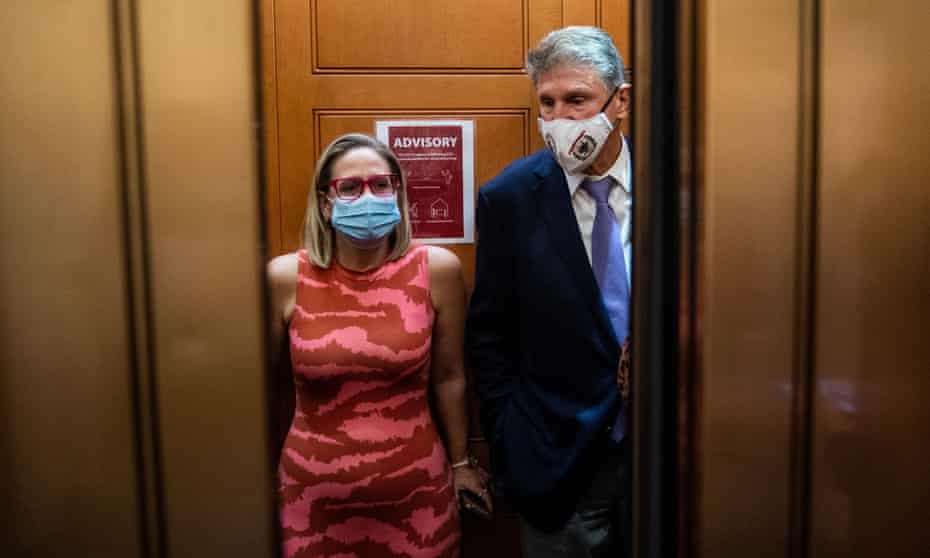
Kyrsten Sinema is at the center of the political whirlwind. Senate Republicans show her a lot of love, pray for her , and try to recruit her to the Republican Party. But at best she’s “warily tolerated” by the White House and Senate Democrats, subject to hostile examination from the Democratic-oriented media, and mostly reviled by Democratic voters. Sinema’s quirky fashion presentation also received a detailed and not at all sympathetic examination by Tressie Cottom in the New York Trimes. Given that Biden absolutely needs Sinema’s “yes” vote to pass anything in a 50-50 Senate, the Arizona senator used to have all the leverage. But the anger and disgust of Arizona Democratic voters has created a situation in which Sinema needs Biden and Senate Democratic support if she wants to be re-elected and that takes away her advantage.
But Sen. Sinema is not just a major player in Biden administration theater. She’s also has a role in the decline of the “center” in American politics. It’s such a familiar story that it’s now part of U.S. political mythology. There used to be moderates like Olympia Snowe, Arlen Specter and Joe Lieberman who could cross party lines to vote, negotiate, work out, and maybe go out for a few drinks later. But that’s almost entirely gone now. There were 59 conservative Blue Dog Democrats in the House of Representatives in 2009 but only 14 in the current caucus. Blue Dog Democrats were easy targets for Republican attacks during the Tea Party wave of 2010 and have generally proved ineffective against prominent conservatives outside the Democratic wave of 2018.
At the same time, conservative leaning Democrats have also been subject to being cancelled by the Democratic base with the most famous case being Joe Lieberman, the Democratic Senator from Connecticut and 2000 vice-presidential candidate whose steadfast support for the failed war in Iraq. invasion led to his being defeated in the 2006 Democratic Senate primary. Lieberman won re-election as an independent but has been in bitter exile from the Democratic mainstream ever since and sought to undermine both President Obama’s and President Biden’s domestic agenda.
But what Kyrsten Sinema doesn’t seem to understand is that Democratic voters have become more partisan over the last 15 years and resent her ostentatious affinity for Republicans just as much as Connecticut Democrats resented Joe Lieberman in 2006. If current trends continue, Sinema will be “Liebermaned” by Democratic primary voters and out of the U.S. Senate in 2024.
From left: Rashida Tlaib (Detroit), Ilhan Omar (Minneapolis) Jamaal Bowman (NYC) Alexandria Ocasio-Cortez (NYC) Ayanna Pressley (Boston) Picture from @Cori Bush
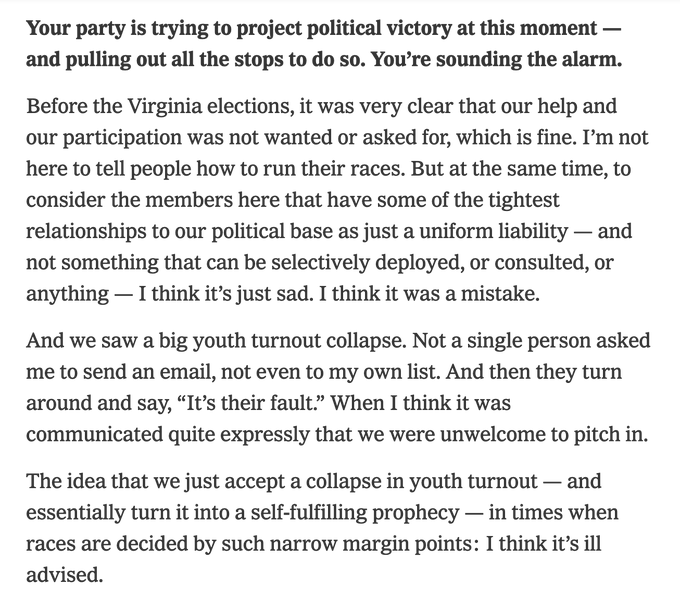
I copied this @AOC statement from a twitter thread by Magdi Semrau (@magi_jay) where she argues that the Democrats need to make better use of AOC and other members of The Squad during political campaigns. Ocasio-Cortez complains about her and members of The Squad being completely shut out by Democratic campaigns “as just a uniform liability” rather than being a resource of any kind. Ocasio-Cortez herself was so marginalized that she wasn’t even asked to send an email to her own list.
Magdi Semrau suggests there are circumstances under which Ocasio-Cortez and other members of the Squad could be usefully deployed to promote the Democratic Party among college students and young constituencies.
I do think [AOC] has a skill set & an ideology that appeals to a very specific set of people: namely, non-voting/sporadic-voting progressive college students. If she’s up for it, I think there are ways to utilize that skill set.
Agreed! And I especially agree with the idea of the Democrats having Ocasio-Cortez and other members of the Squad visit college campuses on a regular basis and “encourage voting.”
But I think there’s more justification than Semrau indicates on twitter. Several points.
AOC is Very Good. Ocasio-Cortez is grounded in her positions, sharp, funny, and willing to engage across the political spectrum. She has first hand experience of GOP bigotry and violence and is an ideal person for communicating Democratic perspectives.
Other Squad members. Rashida Tlaib, Cori Bush, Jamaal Bowman, Ilhan Omar, and Ayanna Pressley are all very good as well. They’re all tv regulars and have had to handle criticism. Given her drive and spirited personality, I think Tlaib has the most potential but they’re all good and would stand up well to debate and disagreement in campus settings.
All Dems Now. Despite voting against the Bipartisan Infrastructure Plan, the Squad is operating within a Democratic Party framework and were much better Party citizens during the House infrastructure debates than the moderates. The Squad deferred to Pramila Jayapal as the head of the Progressive Caucus and Nancy Pelosi as Speaker and refused to undercut the legislation despite voting “no.”
It’s Needed: AOC and others emphasize the problems posed by low youth turnout, but there’s also a big opportunity. 65% of 18-24’s and 54% of 25-29’s voted for Joe Biden in 2020 with a 50% overall youth turnout. Raising turnout numbers among among the 18-29 group to the 66% level of the population as a whole is one of the easier paths the Democrats have to improving their electoral position. Having AOC, the Squad and other Democratic figures circulating among young voters on a regular basis can be a a big electoral help and the Democrats need to put real resources into the effort.
The GOP. Conservatives are already doing this. Well-funded groups like Turning Point USA, Young Americans for Freedom, Campus Crusade for Christ are active on college campuses. Conservative megachurches have full-time youth outreach operations that target kids at early ages. The right believes in full-time, multipronged outreach and much of it is billionaire funded. Democrats need to step up with something like equivalent funding for their own outreach.
In my recent “Do More With Rural Dems” post, I discussed some of the things the Democratic Party could do to scratch for votes in rural areas like my region of Eastern Kentucky. It would also help the Democrats to send people out to colleges like Morehead State University on a regular basis.
We’ll get to Kyrsten Sinema and Joe Manchin in a second.
The City has an interesting article on New York City Council becoming majority women for the first time and the replacement of three more conservative Council members from the Bronx with progressive Latina women. Men rooted in the Bronx “borough’s evangelical Christian or business communities . . . , Fernando Cabrera, Ruben Díaz Sr. and Mark Gjonaj” either retired or were term-limited out of office and replaced by Democrats Pierina Sánchez, Amanda Farías and Marjorie Velázquez.
In other words, Both Sinema and Manchin are politically homeless while holding office as Democratic senators.
It’s helpful to think about a part of the white working class population as politically homeless as well. In a recent (but undated as far as I can tell), Andrew Levison of The Democratic Strategistfollows up on some research by unions to divide WWC voters into categories of Democrats, Extremists, and Cultural Traditionalists with the “Cultural Traditionalist” category being the group to whom Democrat direct their political messaging. What makes men and women in the cultural traditionalist camp “gettable” for Democrats is that they agree with ideas of diversity, pluralism, and tolerance even as they have a herrenvolk orientation toward the flag, patriotism, and religion that I would think also makes them open to appeals from the extreme right. Levinson also argues that “traditionalists” have a strong commitment to the local community which Levinson views as something in common with the extremists but which I believe could cut both ways given the decline of rural communities here in KY and across the country.
Given that Levinson only hopes to get the Democratic share of the WWC vote back up to the 2008 level of 40%, he appears to (realistically) assume that Democrats could not appeal to a majority of Cultural Traditionalists. But he sees Democrats as potentially appealing to some Cultural Traditionalists among the WWC because that constituency doesn’t identify with Republican Party extremists and only reluctantly or unenthusiastically voted for Trump. In other words, there is a segment of the WWC “Cultural Traditionalist” vote that is uncomfortable with both parties, politically homeless, and therefore could potentially vote Democratic in local, state, and national elections.
I grew up in small town Upstate NY (Waverly in the Southern Tier) and have been living in rural Kentucky for the last 30+ years. From my perspective, Levinson’s own recommendations for themes seem awkward and ineffective:
“1. The America that the extremists are fighting for is not the America I grew up in.” “2. I love the American flag as much as any American but I would never use a flagpole flying our flag as a club to assault other Americans that I call my “enemies.” That is not the American way.” “3. The values I grew up with are good values and I want them to endure. But the values of the people who want to turn Americans against each other and divide our country are not my values.” “4. Decent people can stand up for traditional American values without turning America into something that is deeply un-American.”
That’s all defensive and unappealing. I can’t imagine anyone in KY changing their vote on the basis of those arguments. Let me suggest some alternative themes that have a better chance of working.
Effective and active government. Effective government was stressed by Bronx Latina progressives, but I heard the same at a Democratic rally here in Rowan County, KY. The local county Judge-Executive and Morehead City mayor both talked of effective government getting things done in their remarks. It’s a strong theme that can work. Given the American rescue plan and the Infrastructure, the Biden administration has already shown that it can do the same.
Rebuilding Communities: Rural communities and small cities have been declining for decades and need to be rebuilt. On the positive side that includes jobs, education, medical services, and access to transportation and broadband. But rebuilding also involves the long-term work of drug rehab, adult education, and family courts. The Democrats need to be able to make this a plus as the Infrastructure and Build Back Better bills are implemented.
Choices for Young People: It’s been known for a long time that the best, brightest, and most ambitious young people leave their towns. One thing the Democrats could do is pose their community building efforts in terms of giving young people a real option of staying in their home towns if they want. That’s something that speaks to the community attachment element of “Cultural Traditionalism.”
Political homelessness is a structural element in a political system in which the two major political parties are rapidly becoming more polarized. One thing the Democrats need to do is to pose themselves as the better option for those among the politically homeless who are open to their message.
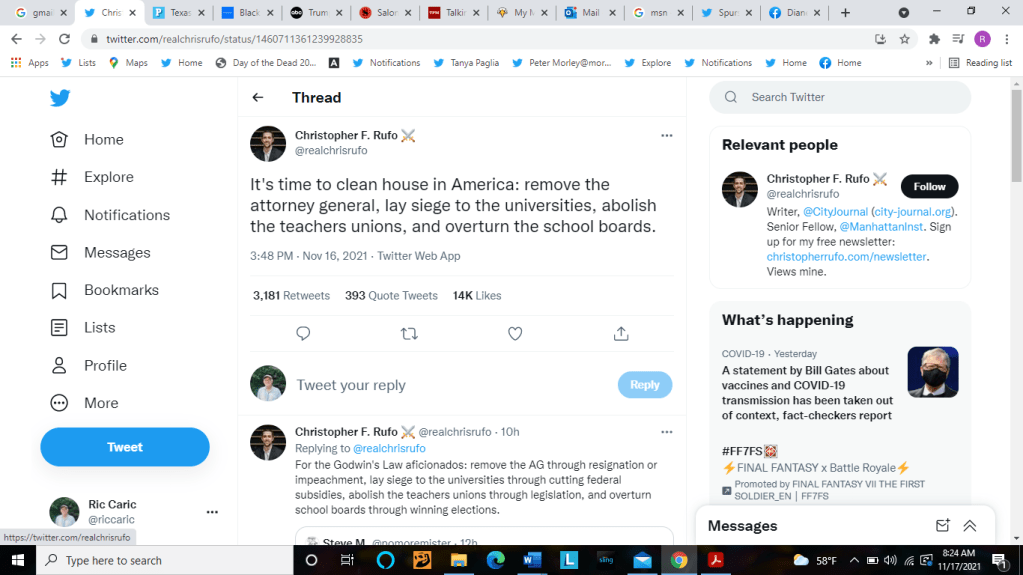
Last night, Christopher F. Rufo, Manhattan Institute Think Tanker, and propaganda genius behind the GOP crusade against Critical Race Theory, came out as a fascist on twitter. Rufo’s language of “time to clean house,” “laying siege,” “abolishing” and “overturning” is all violent rhetoric advocating the destruction of any institution that runs counter to the bullying, bigoted white conservative vision of America and is a complement to J.D. Vance’s rhetoric on destroying corporations if they remain “woke” and oppose “the values and virtues that make this country great…”
Rufo has a follow-up tweet which seeks to provide plausible deniability in relation to accusations of fascism. But that’s B.S. The original tweet pointed to a reactionary overturning of American institutions and one of the few things Rufo did not advocate along that line was the violent overthrow of the Biden administration.
Since January, gas prices have been continuously increasing and have reached $3.415 nationwide and a whopping $4.682 in California. High gas prices are particularly burdensome on populations of people who drive long distances to work whether that’s urban commuters in LA or the people who drive from the 124 miles from Paintsville, KY to work at the Toyota plant in Georgetown, KY outside Lexington. People also commute over distance to work at the University, Hospital, or one of the factories around my town of Morehead, KY. Likewise, the local Walmart Superstore is a magnet for shoppers from isolated rural areas who have little alternative for clothes, school supplies, fresh vegetables, etc.
Political blame for rising gas prices is settling on the Biden administration and they need to both do something and need to be seen doing something. I imagine the Biden administration is considering their options but the easiest thing they can do is to release oil from the Strategic Oil Reserve which was set up as a mechanism for relieving surges in gas prices.
According to Cherise Threewit of HowStuffWorks: “The Strategic Petroleum Reserve is a government-owned stash of oil that’s stored in four salt caverns in the Gulf Coast region. The reserve has a capacity of 727 million barrels (though there are plans to increase storage by expanding the existing caverns and building additional storage sites).”
The Obama administration siphoned 30 million barrels of oil from the Reserve in response to oil market dislocations caused by turmoil in Libya during the 2011 Arab Spring. Given the enormity of the dislocations associated with the pandemic and the need for economic recovery, the Biden administration would be well justified in drawing off however million barrels of oil needed to bring gas prices back down to around $2.50 or whatever they were when Biden took office.
It could be argued that cheap gas is bad climate and environmental policy, but I wonder if that’s true. One effect of high gas prices is to encourage the big oil companies and wildcatters to look for more oil, generate political pressure to open up oceans and wildness preserves to oil exploration, and set up more fracking operations. People use more gas when it’s cheap, but cheap gas reduces the pressure for oil exploration and might be the better climate policy in the long run.





 Early Blackface, Cultural Change, Latest Politics