Recently I came upon a discussion involving ajmrcommunitydavis and others on threads about the “white gaze” in relation to Black writers and public figures. The most famous reference to the white gaze comes from Toni Morrison who refused to write for the white gaze, or, as she put it, “the little white man that sits on your shoulder.” Ignoring the white gaze was artistically liberating– “And the freedom, the open world that appears is stunning. … “There was this free space opened up by refusing to respond every minute to … somebody else’s gaze. So that flavored a great deal of what I was writing. ” Morrison writes of the white gaze as though it is still with her “sitting on her shoulder” and constantly demanding a response from her strenuous efforts to stop responding.
In Occupied Bodies, Recognition, and Riot, my forthcoming book on popular culture in 19th century Philadelphia, I examine the white gaze as a part of a broad transformation of white male popular culture from the 1820’s to the 1840’s. White artists and writers represented Black people as “comic”–as beings whose hyper-extended feet, ape-like faces, bodies covered in fur, and phallicized lips, and noses were not only funny in themselves but gave a preposterous air to their to their whole manner as they shopped for hats, had tea, promenaded on the streets, or walked near the river. Artists like Edward Williams Clay, songwriters like William Clifton, and blackface musicians like Dan Emmett didn’t just employ racial stereotypes, they defined the whole being of Black people as absurd and abominable, as “comic substance” whose monstrosity compelled white people to look at them and laugh. More than fifty years later, W.E.B. DuBois captured the comic dimension of the white gaze when he reflected on “always looking at one’s self through the eyes of others, of measuring one’s soul by the tape of a world that looks on in amused contempt and pity.”
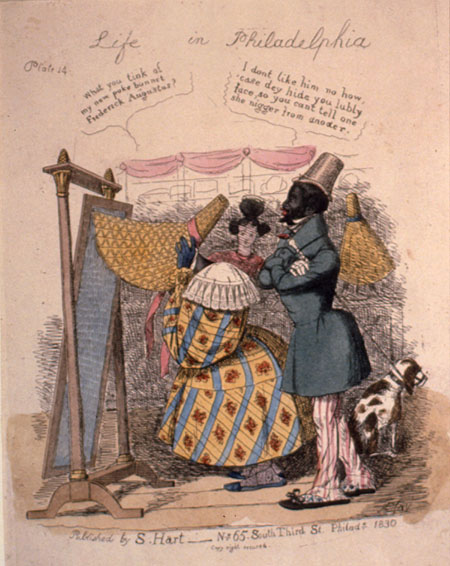
The white gaze was also an exercise in white racial power that involved imposing fantastical suffering on fictional black characters and witnessing a series of scenarios in which the abuse, dismemberment, and suffering of Black people was portrayed as the height of comedy. The sadism of the white gaze can be seen in the early blackface song “Jim Along Josie” in which the comic nature of black characters led to their waistcoats lighting on fire and cob sauce boiling in a tooth. Such images of Black suffering tied to their supposed comic nature were legion and included being run over by trains, suffering impromptu beatings, drowning from inhuman foolishness, and being blown up after swallowing a hogshead of molasses. In Love and Theft, Eric Lott cites the blackface songs of the 1840’s as portraying Black people “roasted, fished for, smoked like tobacco, peeled like potatoes, planted in the soil, or dried and hung up as advertisements.” In this sense, the “white gaze” lifted up the sense of white racial power through the enjoyment of fictionalized Black suffering.
One of the implication of the white gaze in male popular culture was that it was not just a matter of the white “self” in relation to a black “other.” By dressing up in blackface makeup, blackface performers routinely engaged in the transgression of becoming “black” in the sense of adapting “black” identities defined as comic substance and being subject to comically horrific treatment. Thus, the white gaze of 1840’s minstrels also involved white men submitting to the suffering they imposed on fictional Black characters. Taking both the position of the white man inflicting death and humiliation on the black “other” was a powerful cultural maneuver that reinforced the representation of white domination in popular culture and effectively wrote Black people out of the blackness represented in minstrel characters like “Ol’ Dan Tucker,” “Dandy Jim from Caroline,” and ““Jonny Boker.”
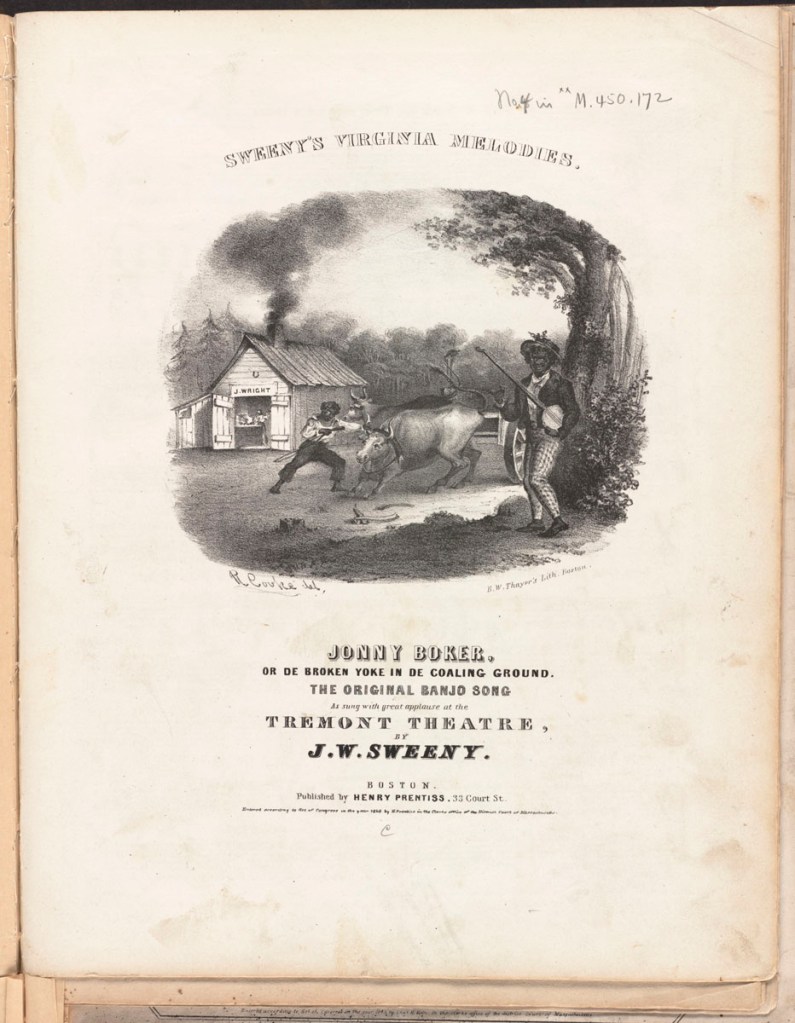
Obviously, the “white gaze” had changed by the time Toni Morrison published The Bluest Eye in 1970 but it was something that carried enormous cultural power from its origins in the rapidly changing white male popular culture of the period from the late 1820’s to 1850.

